



The Core Challenge
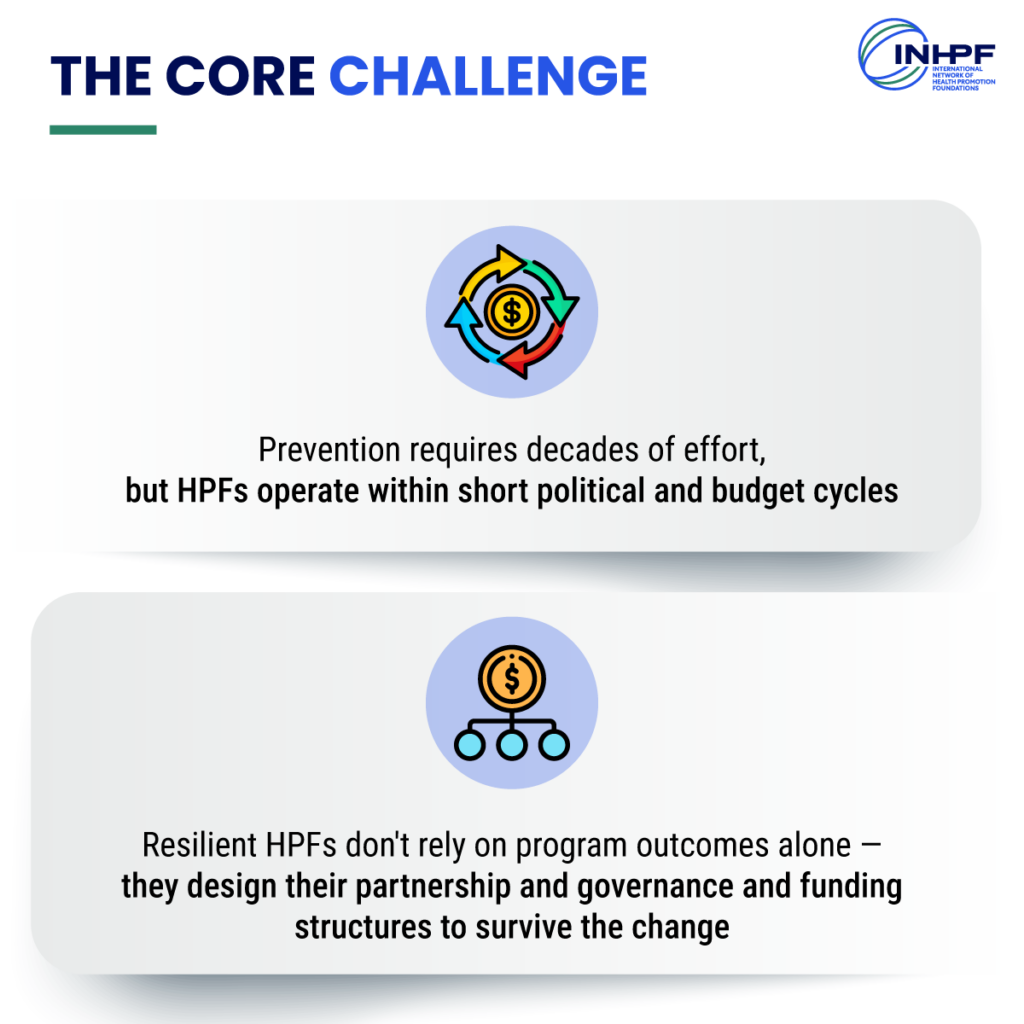
Prevention requires decades of sustained effort to shift population health outcomes and reduce chronic disease burden. However, Health Promotion Foundations (HPFs) operate within much shorter political and budgetary cycles. This is one of the central challenges facing health promotion and prevention leadership today.
To secure sustainable investment and support, successful HPFs do not rely solely on health outcomes of the programs. Instead, they proactively build institutional resilience by designing their strategic alliance, governance models, and funding structures to ensure the buy-in of many stakeholders for their critical work. Whether through partnerships, multi-party board representation, legislative tax protection, or multi-year funding agreements, resilient governance is the foundation that ensures health promotion continues to flourish regardless of shifts.
Strategies for Institutional Resilience
Health and Wellbeing Queensland (HWQld): Extending Reach and Impact Through Strategic Alliances
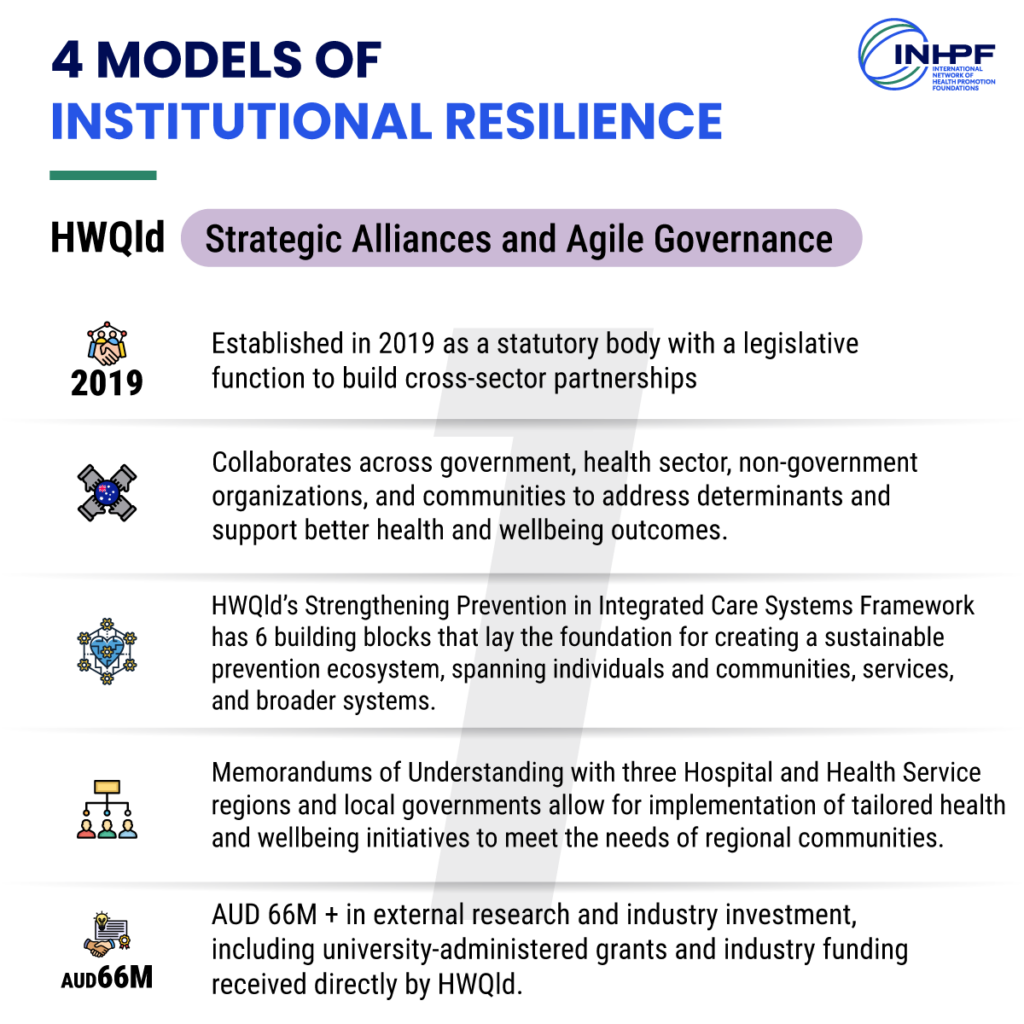
Established with bipartisan support in 2019, Health and Wellbeing Queensland is a dedicated statutory body focused on improving health and wellbeing and reducing the burden of chronic disease across Queensland. Its establishment recognized that prevention requires sustained leadership, long-term investment and coordinated action. Health and Wellbeing Queensland’s resilience is strengthened by its clear legislative mandate, and cross-sector partnerships that support evidence-informed, equity-focused prevention.
Broad-Scale Collaboration: A core HWQld function under its establishing legislation is to develop partnerships and collaborate with other entities to further its objectives. This provides a strong foundation for working across sectors, including state and local government, universities, non-government organizations, peak bodies, local communities, hospital and health services and national prevention partners.
Innovative Partnership Models: Health and Wellbeing Queensland places a strong focus on strategic partnerships to extend the agency’s reach, influence and impact. By bringing partners together around shared priorities, evidence and community insights, Health and Wellbeing Queensland supports prevention initiatives that can be designed, implemented, adapted and sustained across diverse Queensland settings. For example, Memorandums of Understanding with three Queensland Hospital and Health Service regions provide a structured framework to address local health and wellbeing priorities. Collaboration with local councils allows for implementation of tailored health and wellbeing initiatives that align with the unique requirements of regional communities. The agency’s Strengthening Prevention in Integrated Care Systems Framework underpins Health and Wellbeing Queensland’s commitment to collaborating with cross-sector stakeholders within and beyond the health system. The Framework’s six building blocks lay the foundation for creating a sustainable prevention ecosystem, spanning individuals and communities, services, and broader systems.
Measurable Success and Impact: Health and Wellbeing Queensland’s partnerships have supported tangible outcomes across prevention, research translation and system capability. One example is through strategic engagement with the university sector and other partners. The agency has supported more than AUD 66 million in external research investment, including university administered research grants, formal research partnerships, and industry funding received directly by Health and Wellbeing Queensland. These outcomes demonstrate the value of Health and Wellbeing Queensland’s partnership model in strengthening prevention capability, supporting evidence-informed action and extending benefits for Queensland communities.
Victorian Health Promotion Foundation (VicHealth): Multi-Party Governance and Continuity
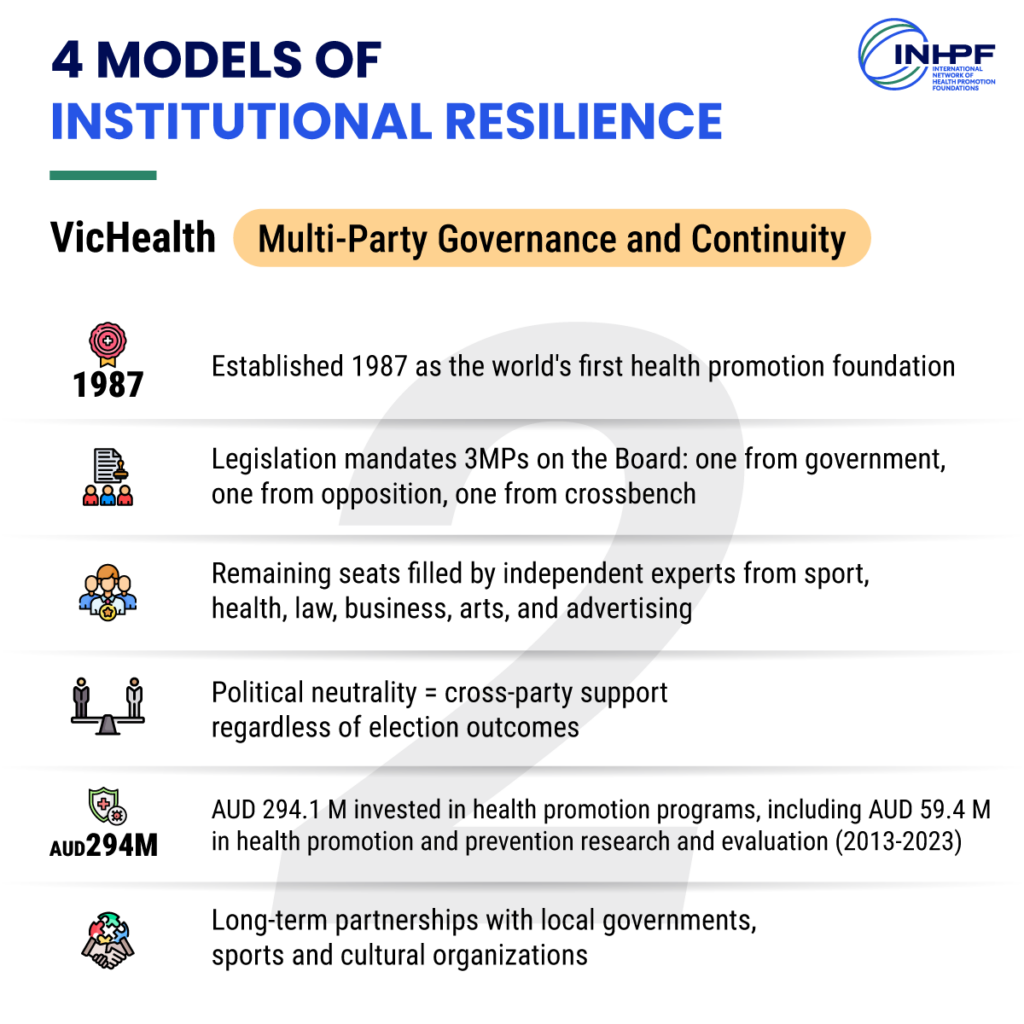
Established in 1987 as the world’s first health promotion foundation, VicHealth’s founding legislation embedded political neutrality directly into its governance structure leading to multi-party commitment to and engagement in its mission.
Multi-Party Representation: As an independent statutory body, VicHealth reports to the Victorian Minister for Health and State Parliament. Within this context it holds autonomous decision-making for its approved budget, overseen by its Board. The cornerstone of its 40-year legacy is legislation mandating three Members of Parliament on the Board: one from government, one from opposition, and one from the crossbench. This multi-party structure, widely cited as one of VicHealth’s greatest institutional strengths, ensures cross-party champions are always present to advocate for the foundation, making its decision-making mission focused and less affected by election cycles.
Innovative Governance Models: The remaining board seats are filled by independent experts drawn from sport, health, law, business, the arts, and advertising. This combination of elected officials and multidisciplinary leaders grants VicHealth unparalleled credibility, allowing it to operate transparently and with the trust of various community leaders, with fewer bureaucratic constraints while remaining aligned with broader government health priorities
Measurable Success and Impact: This governance model, alongside its diverse expertise, long-term partnerships and prevention capability, has enabled VicHealth to pursue ambitious, multi-year initiatives with confidence. Over 2013–2023, the foundation invested AUD 294.1 M in health promotion programs, including AUD 59.4 M in health promotion and prevention research and evaluation. Board stability has also fostered enduring partnerships with local governments and sports organizations, resulting in long-term place based projects and community health campaigns that reach all segments of the Victorian community.
Thai Health Promotion Foundation (ThaiHealth): Executive Buy-In and Legislative Protection
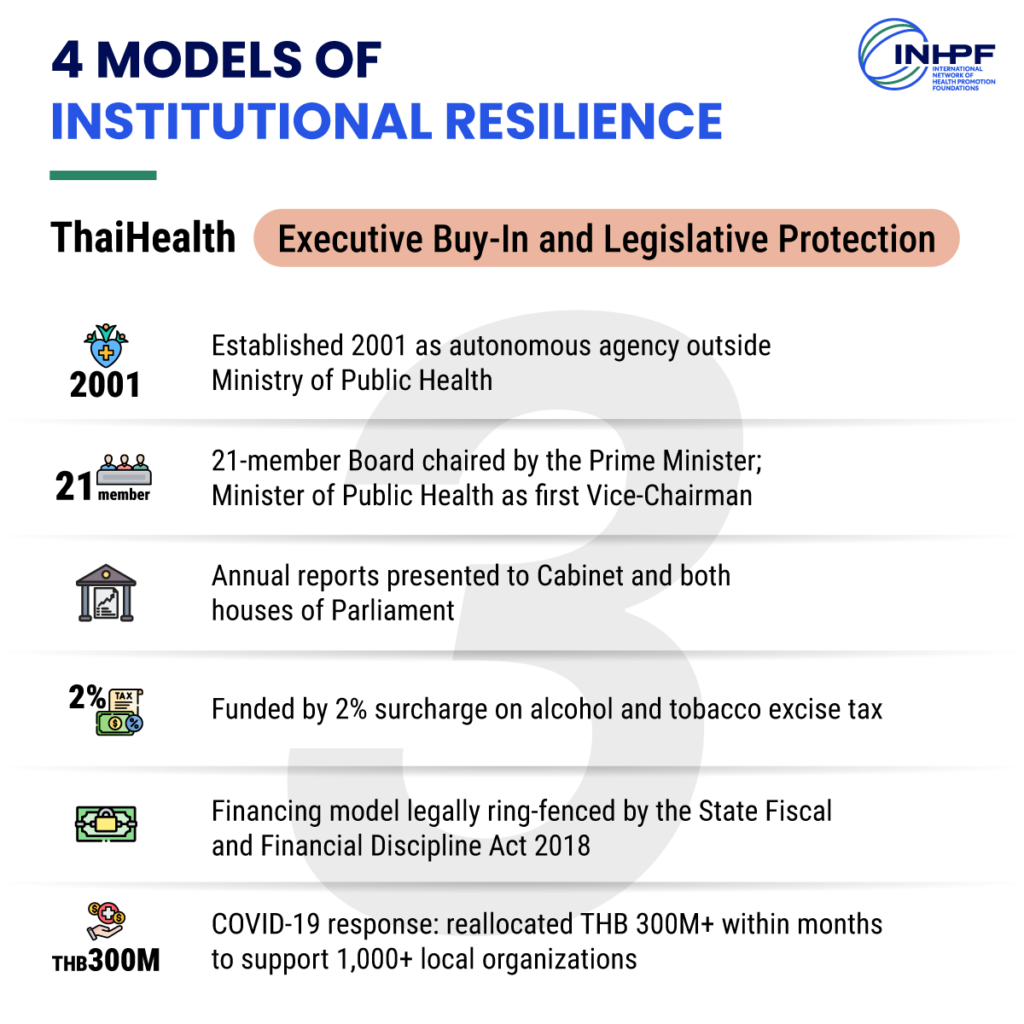
Established in 2001 as an autonomous state agency outside the Ministry of Public Health, ThaiHealth has built institutional resilience by combining high-level executive engagement with legislative financial protection, ensuring its long-term health initiatives remain both politically supported and financially secure.
Executive Buy-In and Accountability: ThaiHealth’s 21-member multi-sectoral Board is chaired directly by the Prime Minister, with the Minister of Public Health serving as first Vice-Chairman. This structure secures immediate, high-level political buy-in at the highest level of government. Annual reports are presented directly to Cabinet and both houses of Parliament, incorporating their feedback into strategy, keeping ThaiHealth responsive to public scrutiny while preserving its operational independence.
Innovative Governance and Financial Protection: ThaiHealth is funded by a 2% surcharge on excise tax from alcohol and tobacco products. Critically, this financing model is enshrined in the State Fiscal and Financial Discipline Act of 2018, which legally ring-fences these funds exclusively for health promotion, insulating them from broader budget fluctuations or shifting administrative priorities.
Measurable Success and Agility in Crises: The combination of secure funding and operational autonomy gives ThaiHealth exceptional agility in responding to emerging challenges. During COVID-19, ThaiHealth rapidly reallocated over 300 million baht within months, deploying funds to launch public health communication campaigns, verify pandemic information, and support over 1,000 local organizations in implementing community-level prevention measures. This rapid pivot stands as a compelling demonstration of what resilient governance enables in practice.
Health Promotion Board Singapore (HPB): Stability Through the 5-Year Block Budget
While many HPFs seek financial separation from the government, HPB Singapore demonstrates that institutional resilience is achievable even within a government ministry. Established in 2001 under the Ministry of Health (MOH) as a statutory board, HPB leads national health promotion and disease prevention efforts, and has secured a funding mechanism that effectively shields it from annual budget pressures.
Multi-Year Budget Agreements: Rather than negotiating funding annually, HPB operates on a 5-year block budget provided by the MOH, tied to agreed performance indicators. This multi-year commitment gives HPB stable, predictable resources to plan and execute long-term health promotion initiatives effectively insulating it from short-term economic fluctuations and shifting ministerial priorities.
Innovative Governance and Internal Agility: HPB’s Board of Directors draws independent members from academia, finance, and the private sector. A key advantage of the block budget is the internal flexibility it provides, allowing HPB to reallocate resources within the budget cycle as new public health challenges emerge. Accountability is maintained through annual MOH and Parliament reports, alongside a mid-cycle strategic review to ensure the agency remains on track.
Measurable Success and Impact: HPB’s stable funding has enabled ecosystem-wide initiatives requiring sustained investment. HPB plays a central role in Healthier SG, the MOH’s national preventive health program launched in 2023 that reorients the healthcare system toward proactive health management. Financial stability has also supported the Healthy 365 mobile application, a long-term digital health infrastructure investment used by approximately one quarter of Singapore’s adult population by 2023 to track physical activity, access health programs, and earn rewards.
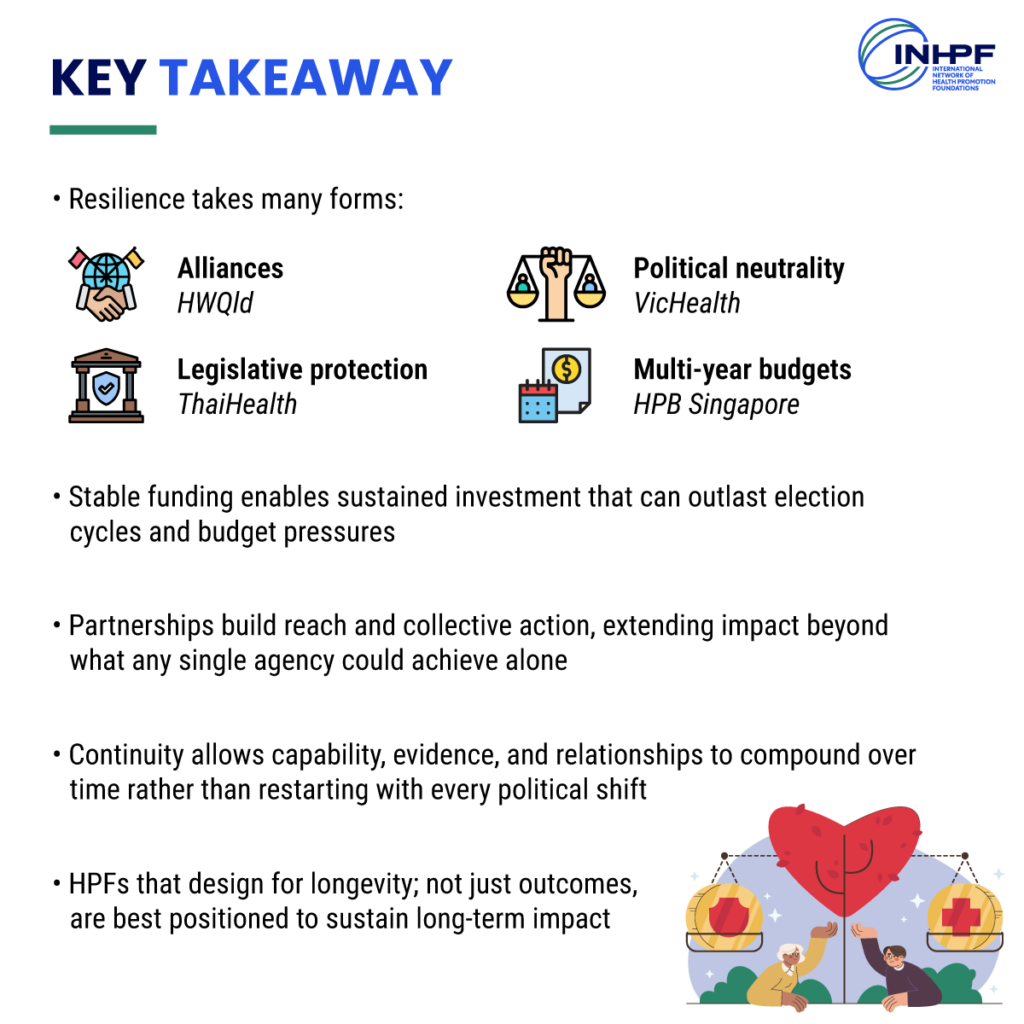
Download the full infographic
Explore four real-world models of institutional resilience from leading Health Promotion Foundations and discover how governance, partnerships, and sustainable funding help protect prevention through political and budgetary change.
Surviving the Shift: Sustaining Health Promotion Through Change
Read next
Explore how Health Promotion Foundations strengthen the economic case for prevention by demonstrating return on investment, economic value, and long-term public investment.
The Economics of Prevention: Proving Impact to Governments
Explore the Network
Explore the INHPF network and discover how Health Promotion Foundations collaborate globally to strengthen health promotion through shared knowledge, collaboration, and practical learning.
More insights from the Network
Visit our Insights page to explore Articles, Infographics, Member Cases, Report Cards, and other knowledge products developed from the experiences of Health Promotion Foundations across the network.