



The Problem
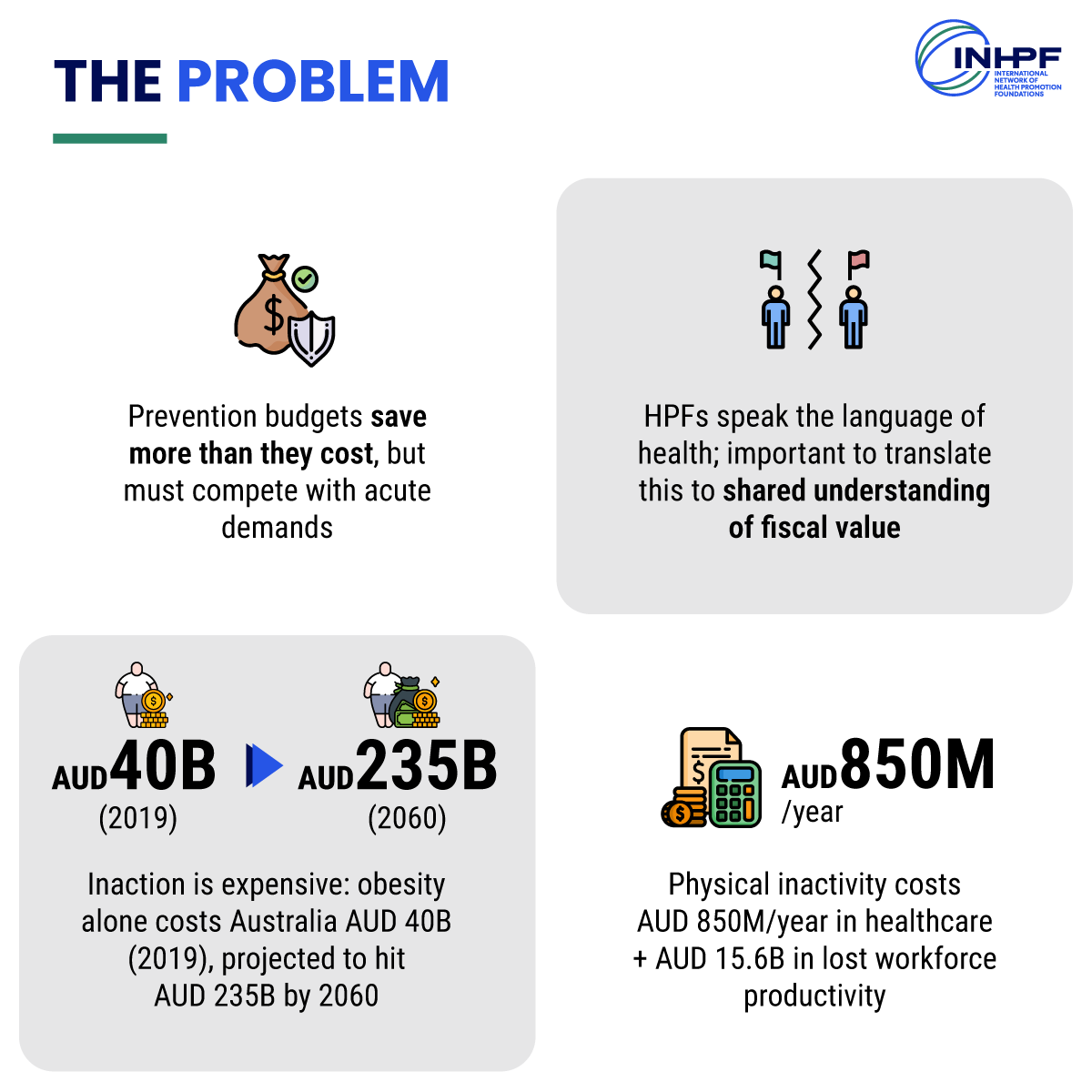
Prevention saves lives, strengthens communities, and boosts productivity. Yet prevention investment remains vulnerable to short-term fiscal pressures because benefits often accrue over longer timeframes and across multiple portfolios. Against the immediate, visible demands of acute care, prevention can be treated as discretionary unless its health, economic and fiscal value is clearly demonstrated.
The cost of inaction is too large to ignore. In Australia, overweight and obesity cost the economy approximately AUD 40 billion in 2019; a figure projected to rise to around AUD 235 billion by 2060 if current trends continue. Physical inactivity also carries a significant economic burden, including direct health system costs and broader impacts on productivity, workforce participation and wellbeing. Physical inactivity costs the Australian healthcare system up to AUD 850 million annually. Studies focused on productivity have estimated annual productivity losses due to physical inactivity to be up to AUD 15.6 billion.
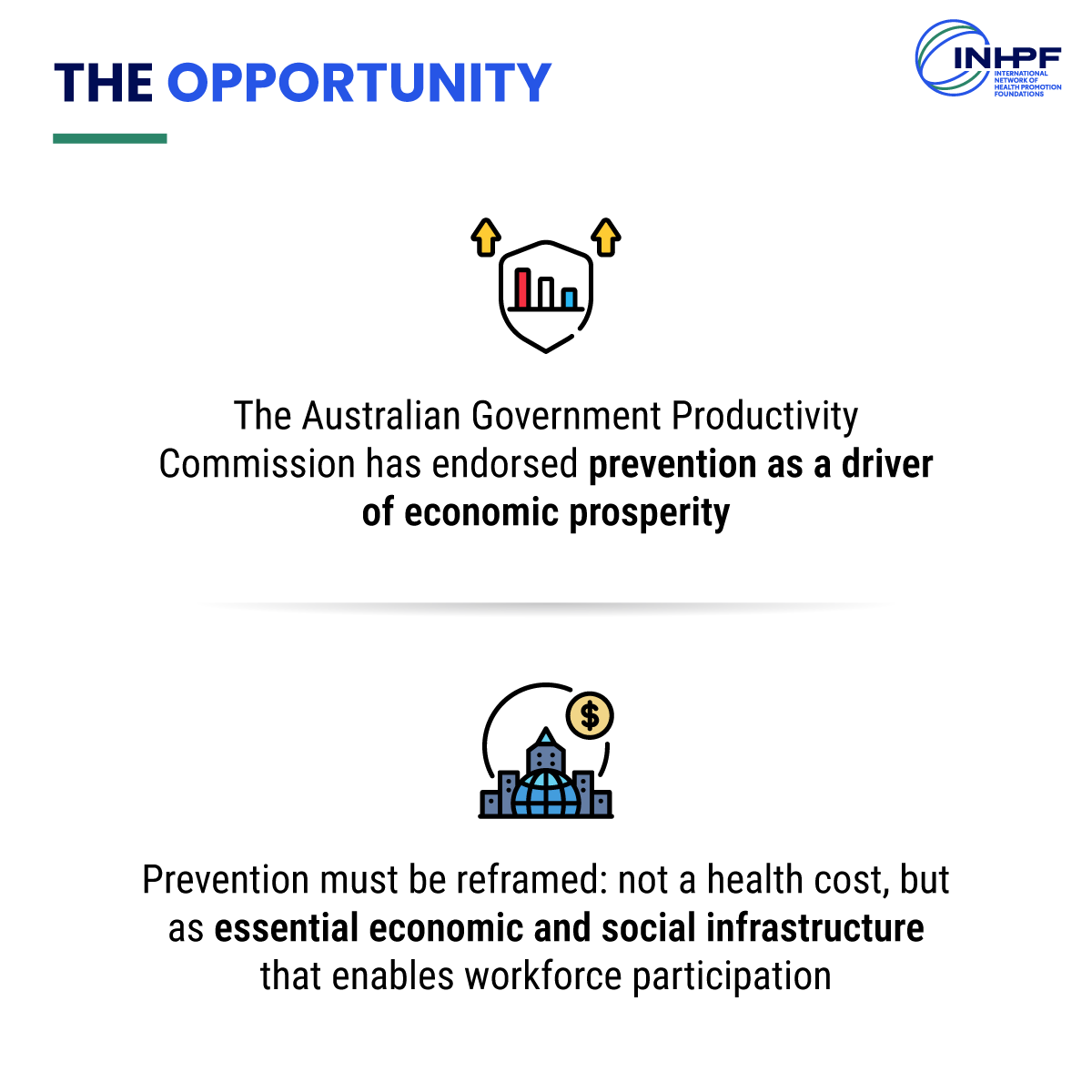
To secure durable government partnerships, Health Promotion Foundations (HPFs) need to strengthen the economic case for prevention: health is simply not a cost pressure; it is economic and social infrastructure. The Australian Productivity Commission’s[SA1] recommendation for a National Prevention and Early Intervention Framework reinforces this shift, recognizing prevention as a strategic investment that can improve outcomes and drive national productivity, workforce participation, and long-term prosperity.
The Shift: Framing Health as an Enabler for Productivity
To navigate the funding paradox, HPFs must reframe prevention as essential economic infrastructure; a shift that has now gained significant national exposure. The Australian Productivity Commission’s inquiry into Delivering quality care more efficiently explicitly recognized prevention as a driver of long-term economic prosperity, recommending a National Prevention and Early Intervention Framework to guide consistent, evidence-informed funding decisions. The framework would support government investment in effective prevention and early intervention programs that improve the outcomes of individuals and the wider community, and reduce demand for services. It would recognize that the benefits of prevention and early intervention can take a long time to materialize and may not align with budget cycles and government departments. This recommendation hands HPFs a powerful blueprint for engaging treasury and finance ministries: prevention is not a health priority competing for budget; it is a system-level investment that sustains productivity, improves workforce participation, and reduces long-term demand on health and social services.
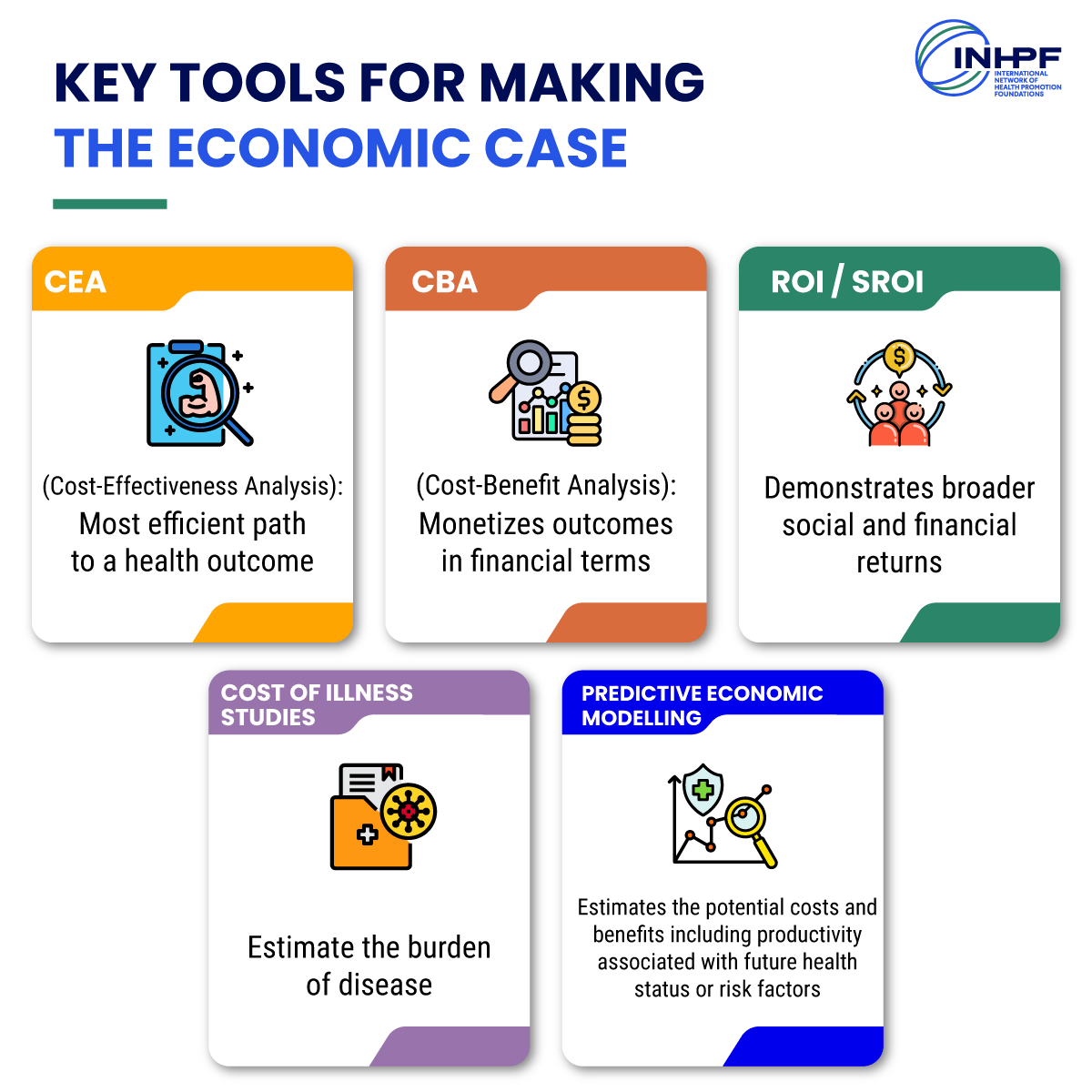
However, translating this vision into investment means clearing a critical hurdle: central agencies typically define Cost-saving as delivering cashable savings within a two-to-five-year window: a challenging metric for prevention, whose full value is realized over decades. HPFs must therefore leverage health economics to bridge the gap. Cost of illness studies estimate the burden of disease; outlining the cost of preventable issues in this way will underscore why prevention is so essential. Moreover, predictive economic modelling estimates the potential costs and benefits associated with future health status, illnesses or risk factors, displaying the cost of inaction. Cost-Effectiveness Analysis (CEA) identifies the most efficient path to a health outcome; Cost-Benefit Analysis (CBA) monetizes that outcome in broader financial terms. Combined with ROI and Social Return on Investment (SROI) frameworks, these tools reframe the conversation, demonstrating prevention’s broad economic benefits.
How HPFs are Proving Financial Value
To move from theory to practice, several leading Health Promotion Foundations (HPFs) have successfully integrated economic framing into their core strategies. By utilizing metrics, economic evaluations, and systemic impact frameworks, the work of these organizations provides a guide for how to advocate for sustainable funding mechanisms and sources.
Health and Wellbeing Queensland (HWQld): Avoiding Hospitalizations
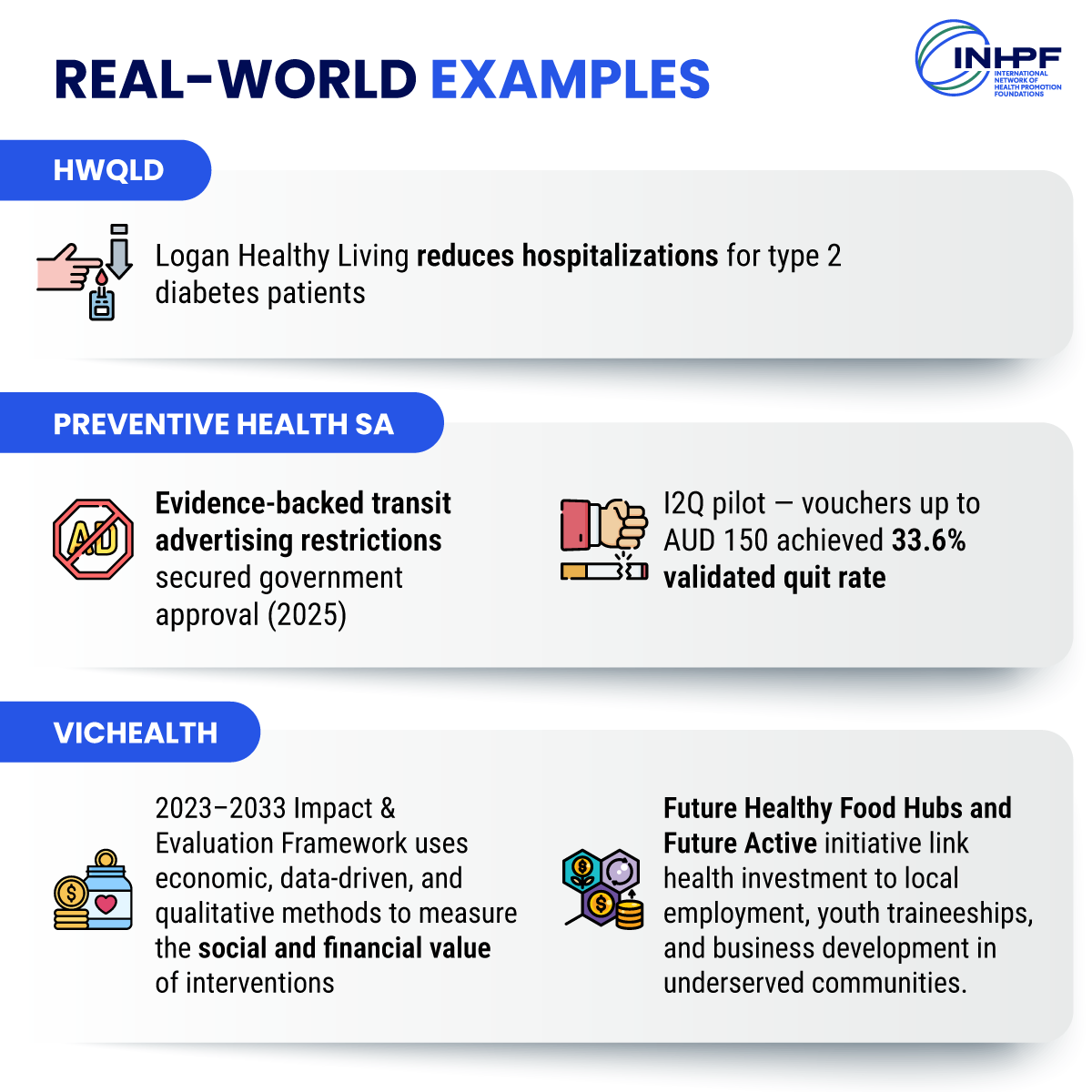
- Avoided Healthcare Costs: Through partnerships across the preventive health ecosystem, HWQld has delivered initiatives like the Logan Healthy Living pilot program, targeting individuals at risk of, and living with, type 2 diabetes, providing a lifestyle management program that effectively reduced hospitalizations.
- Investing in Local Economic Evidence: Recognizing that central agencies require robust, localized data, HWQld actively invested in building its own economic evidence base. For example, an evaluation of the Logan Healthy Living pilot found an average of AUD 1.64 million annual direct benefits to participants collectively and an average of AUD 1.35 million in socio-economic benefits. Additionally, for every dollar invested in the program, AUD 1.82 of value was generated, demonstrating an 82% return on investment.
Preventive Health SA: Using Economic Evaluations to Drive Policy
- Evidence-Based Policy Buy-In: When proposing restrictions on unhealthy food and drink advertising on South Australian government transit assets, Preventive Health SA built a multi-faceted case combining an economic evaluation of a similar Western Australian policy, international purchasing data from London, and a local environmental scan. By anticipating industry pushback with proven regulatory evidence, they secured government approval for the policy, effective July 2025.
- Financial Incentives for Change: The Incentive to Quit (I2Q) pilot offered supermarket vouchers up to AUD 150 to hospital patients as rewards for verified smoking and vaping cessation milestones among high-prevalence groups, achieving a 33.6% validated quit rate. This demonstrates how direct economic incentives can drive measurable health outcomes and long-term cost avoidance.
Victorian Health Promotion Foundation (VicHealth): Integrating Systemic Frameworks and Place-Based Economic Investment
- Evaluating Economic Impact: VicHealth’s 2023–2033 Impact and Evaluation Framework tracks system shifts and population health using economic, data-driven, and qualitative methods. This includes building a methodology so that the health and economic value of different types of VicHealth’s work can be assessed on equal terms.
- Health as Local Economic Development: VicHealth’s Future Healthy Food Hubs invested AUD 4 million across seven high-need areas, improving food access while supporting local growers through business accelerators and youth traineeships. Similarly, the Future Active initiative empowered youth to redesign underutilized spaces, creating employment pathways alongside increased physical activity. Expanding this economic impact to policy development, a VicHealth Research Impact Grant currently funds a Monash University-led team to build a tool that helps local governments identify the most cost-effective strategies for increasing active travel. Together, these programs demonstrate that preventative health initiatives function as direct economic development, not just traditional health spending.
- Measuring Social Value: VicHealth is supporting the community sport sector to demonstrate the social value of sport using the Australian Social Values Bank. This methodology draws on a bank of robust social values with an online tool that translates the net benefit of a program’s social impact in dollars, using cost benefit analysis.
A Framework for HPFs: Building the Economic Case
Securing sustainable funding mechanisms and sources requires HPFs to establish a common language with decision-makers, utilizing a flexible economic translation approach tailored to the specific audience and context.
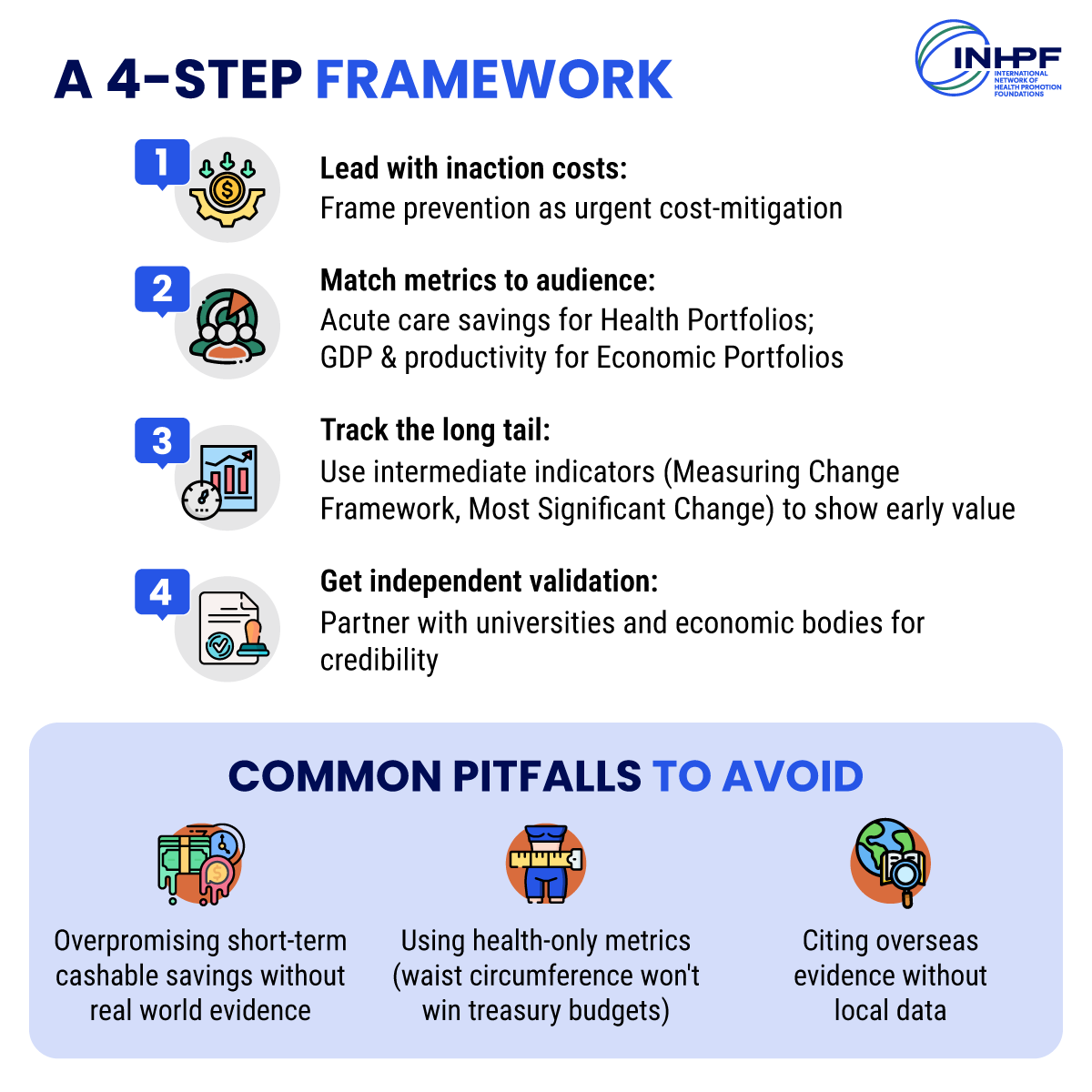
- Identify the economic burden: Anchor the pitch in the financial cost of doing nothing. The Australian Productivity Commission’s work, including the Final Report on Delivering quality care more efficiently and Shifting the Dial: Five year productivity review, effectively frame prevention as urgent cost-mitigation, not discretionary spending.
- Choose the right metrics for the audience: Tailor economic focus to align with government objectives such as reducing acute care costs. HWQld’s Logan Healthy Living reduced hospitalizations and emergency department visits for those at risk of or living with type 2 diabetes. For economic and workforce related portfolios, tailor by focusing on GDP (or Gross State Product) impact, absenteeism, and labor productivity. Central agencies consistently respond to robust, localized evidence and tangible financial returns. When Preventive Health SA proposed banning unhealthy food advertising on public transit, they paired a Western Australian policy evaluation with local environmental scans, countering industry pushback and securing government approval. Their Incentive to Quit pilot demonstrated the same principle differently: offering vouchers up to AUD 150 for verified smoking and vaping cessation milestones achieved a 33.6% quit rate, proving that targeted financial incentives can deliver measurable outcomes and long-term cost avoidance. VicHealth’s Future Healthy Food Hubs (AUD 4M across seven high-need areas) and Future Active initiative demonstrate this directly, linking health investment to local employment, youth traineeships, and business development in underserved communities.
- Monetize the long tail through systemic measurement: Prevention ROI is fully realized over decades, not budget cycles, so HPFs must track intermediate markers of success such as reduced smoking prevalence or other positive behavioral shifts that correlate with decreased disease risk. HWQld’s Measuring Change Framework captures early signals of system change (shifts in policy, practices and organizational networks) as leading indicators of long-term value, supplemented by qualitative evidence gathered using methods such as Most Significant Change. Complementing this, HWQld in partnership with The University of Queensland’s Health and Wellbeing Centre for Research Innovation has also been able to quantify short-term ROI through the Logan Healthy Living program, reducing the burden of type 2 diabetes for residents and local hospitals. VicHealth takes a complementary approach: a Minimum Data Set standardizes reporting across all funded initiatives, enabling consistent ROI, effectiveness, and equity evaluation under its 10-year Impact & Evaluation Framework.
- Secure third-party validation: Independent economic data carries more weight with treasuries than self-reported impact. HPFs should partner with universities, actuarial firms, and economic bodies to build an impartial evidence base as HWQld did through the Health and Wellbeing Centre for Research Innovation with The University of Queensland, VicHealth with La Trobe University and the University of Melbourne, and Preventive Health SA with the Centre for Health in All Policies Research Translation (CHiAPRT).
Common Pitfalls in Economic Translation
Even with the right framework, HPFs may undermine their own case through these common missteps.
- Overpromising short-term returns: Prevention takes time. Promising immediate cashable savings can damage credibility if not backed by tangible real-world evidence. Ensure program evaluations include indicators that are conducive to economic analysis and focus on tracking intermediate system shifts as leading indicators of long-term economic value.
- Relying on health-only metrics: Presenting data solely on vegetable intake or waist circumference fails to secure treasury funding. Translate metrics to support governments’ fiscal and economic strategy such as productivity gains or healthcare cost savings.
- Citing overseas evidence without local context: Central agencies want to know if a policy will work in their specific jurisdiction. Always adapt international success stories with local economic evaluations and environmental scans.
Moving Forward
Prevention saves lives, but without a compelling economic case, its acute demands will continue to dominate narratives and budgets. The evidence is clear that inaction costs far more than investment, and leading HPFs are already proving this through systemic impact frameworks as well as ROI metrics and localized economic evaluations that speak directly to central agency fiscal priorities.
The path forward is straightforward. HPFs that reframe prevention as economic infrastructure, anchoring pitches in the cost of inaction, tailoring metrics to each specific decision-maker, and securing independent validation will be best positioned to secure the durable government partnerships that public health urgently needs.
[SA1] https://preventioncentre.org.au/news/productivity-commission-prevention-framework/#content
Download the full infographic
Explore key evidence, economic insights, and real-world examples showing how Health Promotion Foundations demonstrate the value of prevention through economic evaluation, return on investment, and system-level impact.
The Economics of Prevention: Proving Impact to Governments
Read next
Explore how governments translate evidence into healthier food policies through front-of-pack nutrition labelling, and how Health Promotion Foundations support policy action for long-term prevention.
Shaping Healthier Food Systems Through Front-of-Pack Nutrition Labelling
Explore the Network
Explore the INHPF network and discover how Health Promotion Foundations collaborate globally to strengthen health promotion through shared knowledge, collaboration, and practical learning.
More insights from the Network
Visit our Insights page to explore Articles, Infographics, Member Cases, Report Cards, and other knowledge products developed from the experiences of Health Promotion Foundations across the network.