


Introduction
Health promotion impact does not happen overnight. It emerges through sustained effort, strong partnerships, and system-level change over time. This insight presents the journey of a health promotion initiative — from identifying priority issues to embedding impact into systems and policies — drawing on experiences from across the INHPF Network.
Rather than viewing health promotion as a series of isolated projects, the journey illustrates how lasting impact is built through coordinated action, continuous learning, and collaboration across sectors.
Why This Journey Matters
Health promotion is often misunderstood as short-term programs or campaigns. In reality, meaningful and lasting change requires a systems approach. Health outcomes are shaped by policies, institutions, environments, and markets, and progress occurs when these elements are aligned toward shared goals.
This journey reframes health promotion as an ongoing process. It highlights how initiatives evolve, adapt to context, and contribute to broader system transformation. By visualizing this pathway, the infographic supports more strategic planning, clearer communication, and stronger learning across health promotion practice.
The Five Phases of the Journey
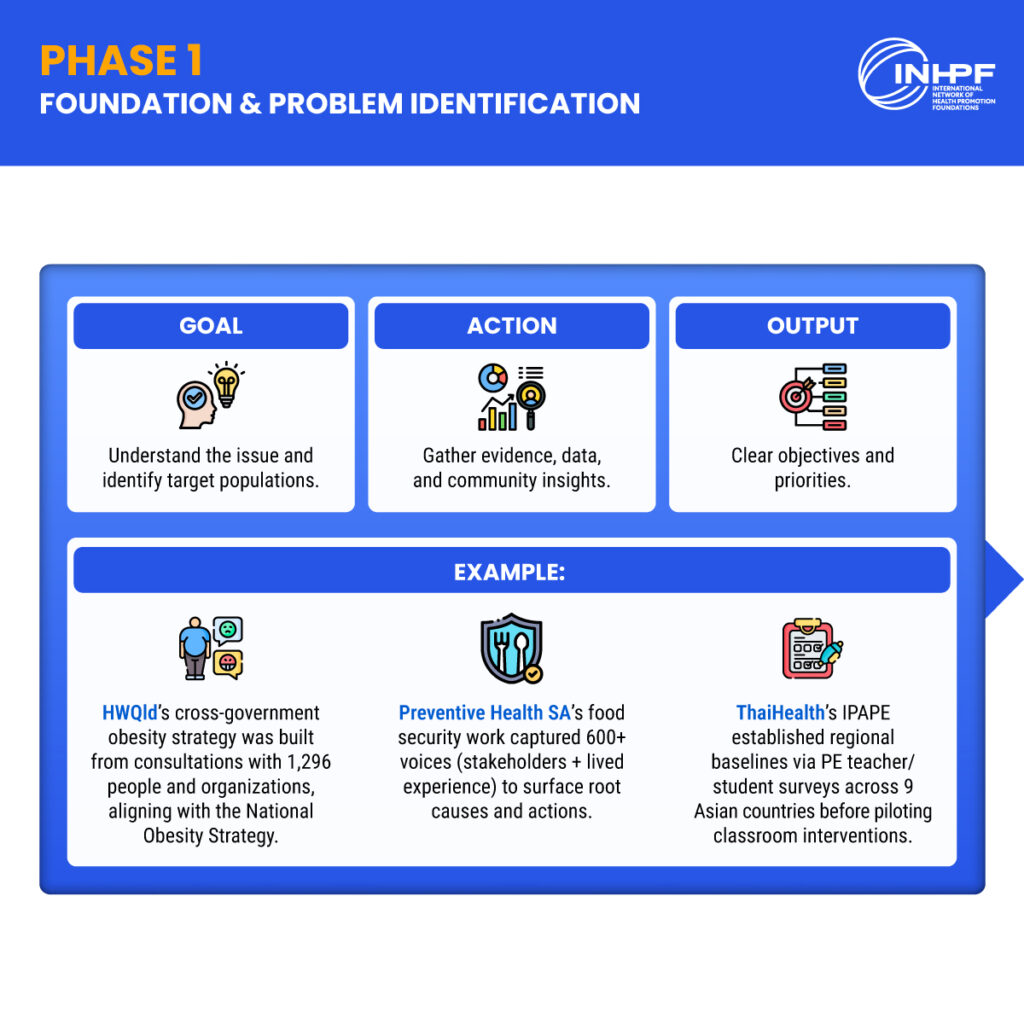
Phase 1: Foundation & Problem Identification
The journey begins with understanding priority health issues, population needs, inequities, and system gaps. This phase draws on data, evidence, and community insights — including lived experience — to define problems clearly and identify target populations.
Strong foundations ensure that health promotion initiatives are relevant, evidence-informed, and grounded in local context.
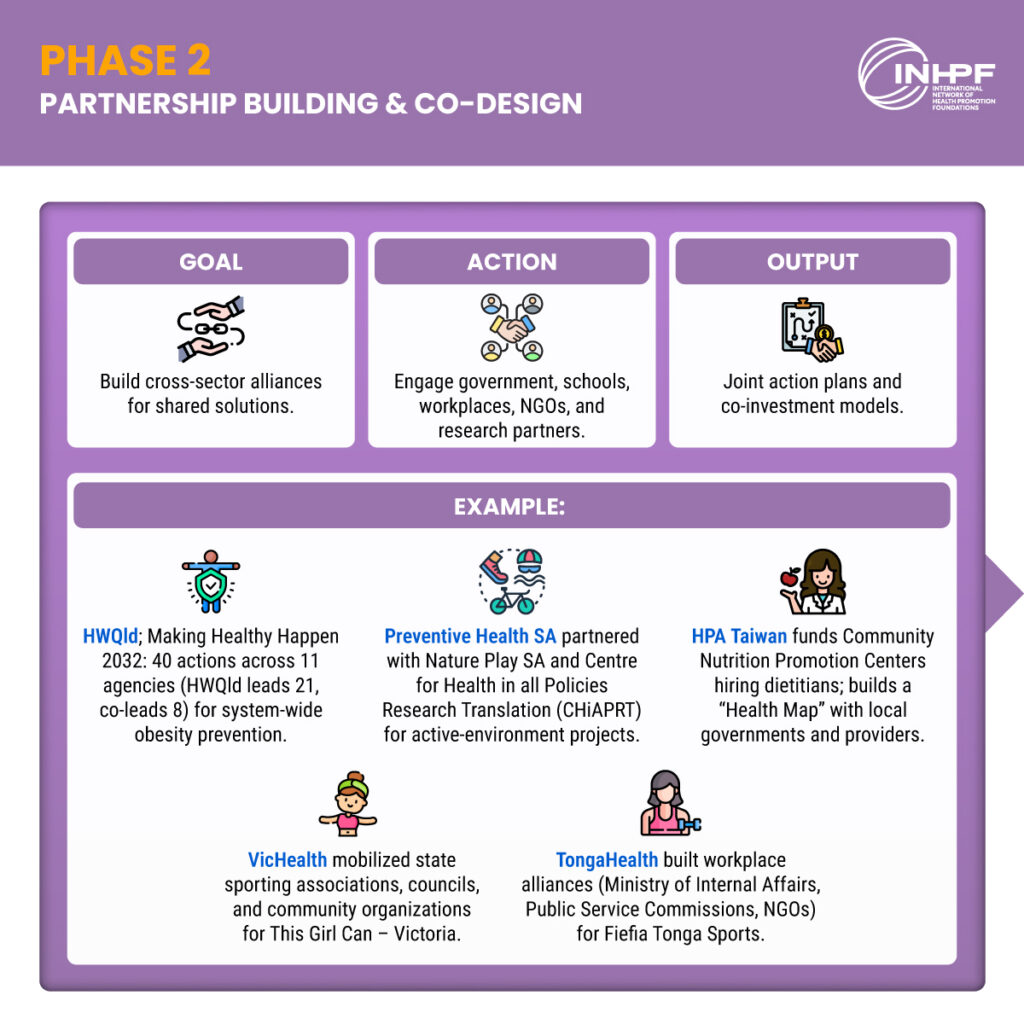
Phase 2: Partnership Building & Co-design
Effective health promotion depends on collaboration. This phase focuses on building cross-sector alliances and engaging partners such as governments, communities, civil society organizations, schools, workplaces, and research institutions.
Through co-design, stakeholders develop shared goals, joint action plans, and co-investment models that strengthen ownership, relevance, and long-term commitment.
Phase 3: Implementation & Delivery
Implementation turns plans into action. This phase involves delivering policies, programs, and community-led initiatives across everyday settings.
Health promotion foundations play a key role by enabling innovation, supporting delivery partners, and facilitating coordination across sectors. Successful implementation balances fidelity to evidence with flexibility to respond to local contexts and delivery settings.

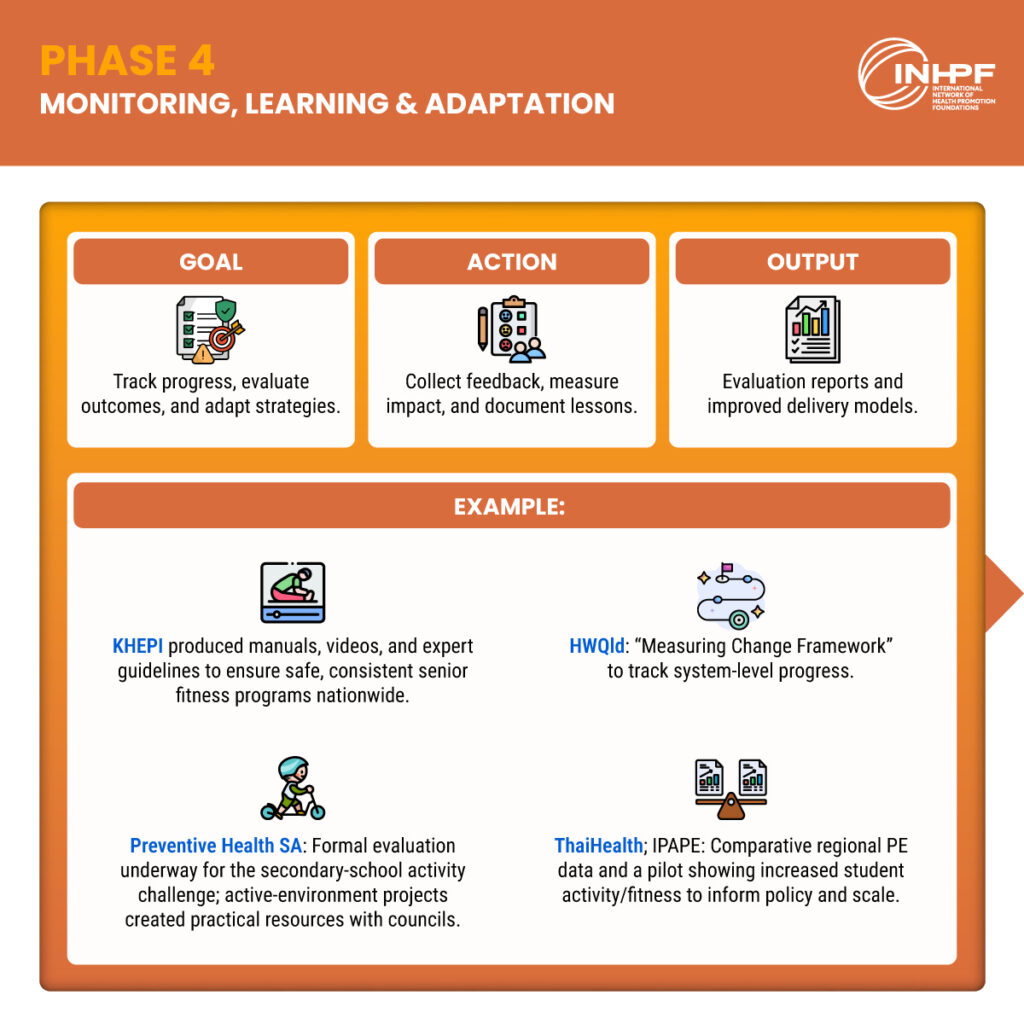
Phase 4: Monitoring, Learning & Adaptation
Learning is central to effective health promotion. This phase emphasizes tracking progress, evaluating outcomes, and documenting lessons from practice.
By collecting feedback and measuring impact, initiatives can adapt strategies over time, strengthen delivery models, and build the evidence base needed for system-level change.
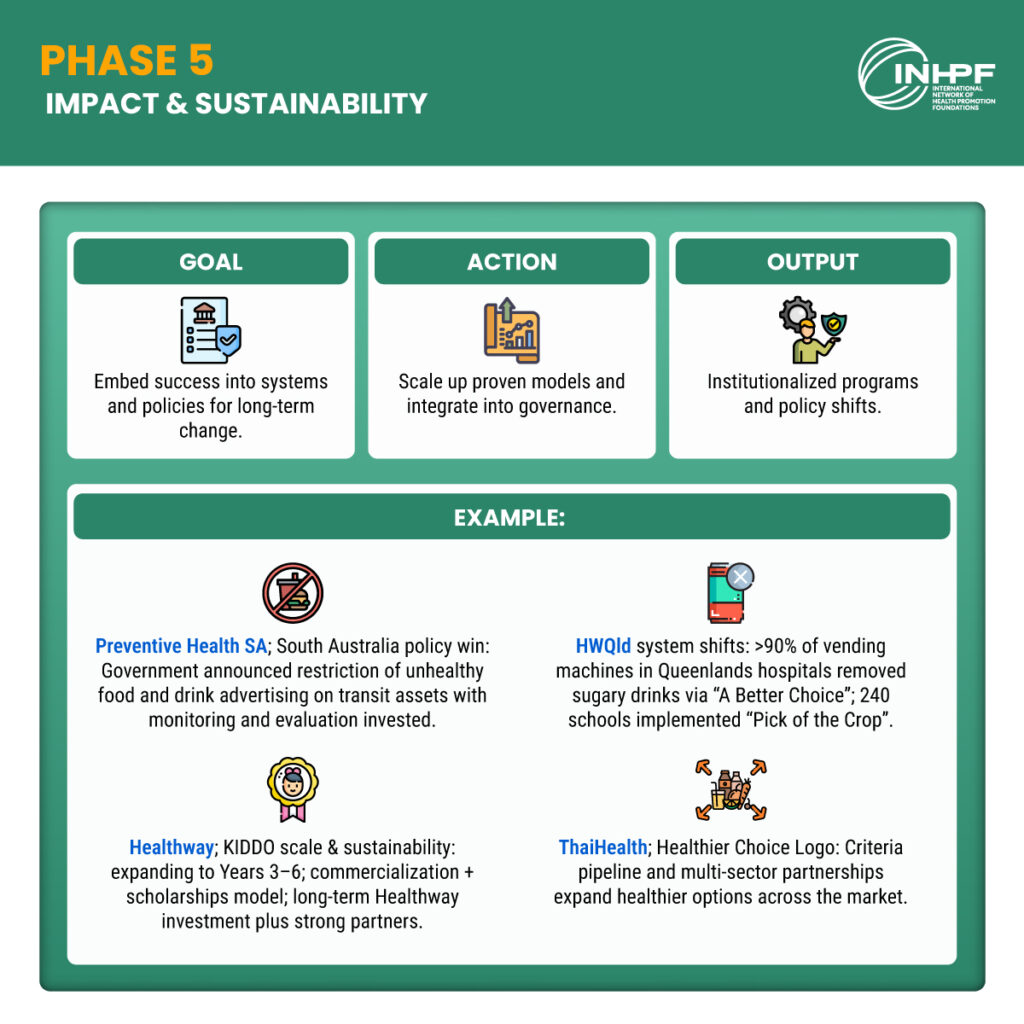
Phase 5: Impact & Sustainability
The final phase focuses on embedding success into systems and policies to achieve long-term change. This includes scaling proven models, integrating initiatives into governance structures, and institutionalizing effective practices.
Rather than representing an endpoint, sustainability often feeds back into new cycles of learning and action, reinforcing continuous system improvement.
The Stakeholder Ecosystem Behind Impact
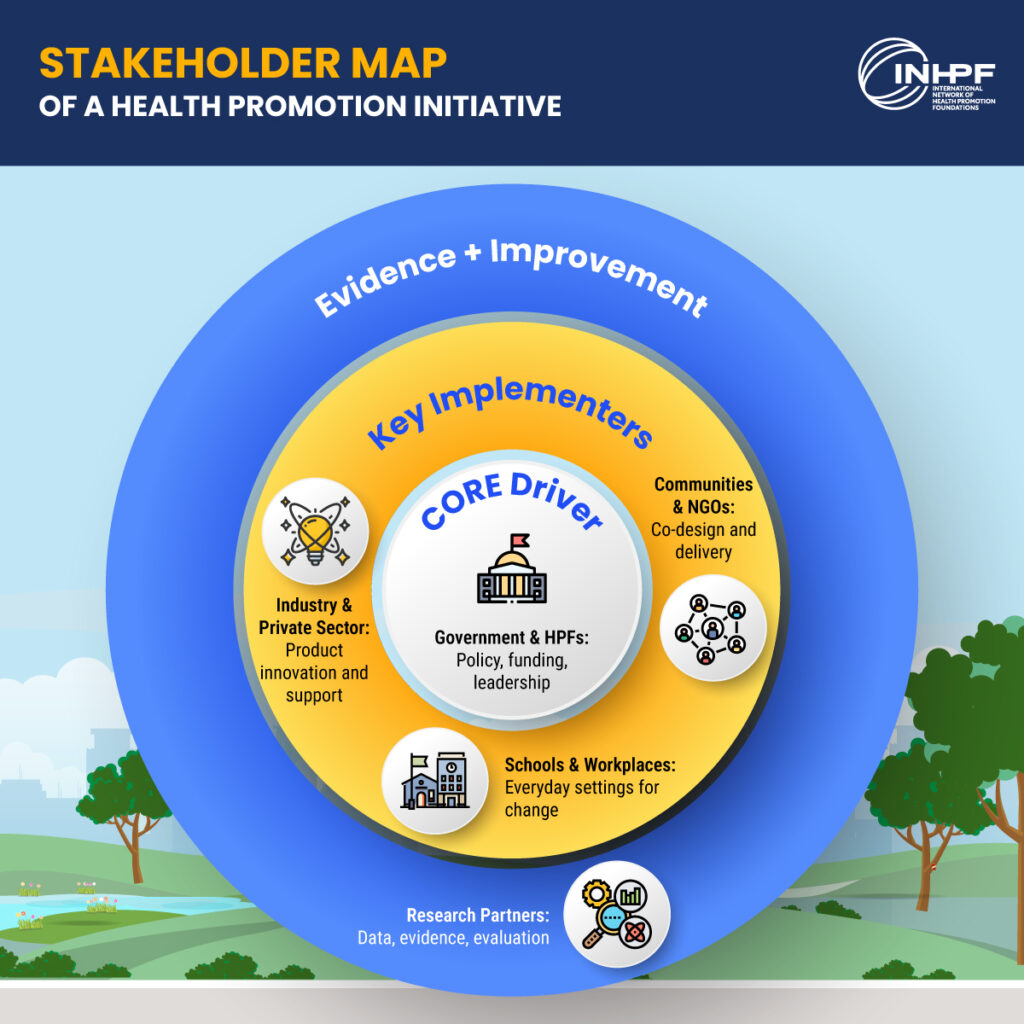
The infographic also highlights the stakeholder ecosystem that supports impact across the journey. Governments, health promotion foundations, communities, civil society organizations, industry, schools, workplaces, and research partners each play distinct but complementary roles.
Health promotion foundations are uniquely positioned as system stewards. By connecting actors across sectors, aligning incentives, supporting long-term investment, and sustaining a focus on prevention, they help ensure that initiatives contribute to broader system transformation rather than isolated outcomes.
How This Journey Can Be Used
This journey provides a shared framework that can be used to:
- Reflect on how initiatives contribute to system-level change
- Support strategic planning, monitoring, and evaluation
- Communicate the value of health promotion to policymakers and partners
- Serve as a learning resource for emerging health promotion foundations and practitioners
While presented as five phases, the journey is not a linear process. Initiatives often move back and forth across phases as contexts evolve, learning emerges, and systems change over time.
By providing a shared framework, the journey helps align understanding and support more strategic action across the health promotion community.
Explore More
This insight is part of the INHPF Insights Series, which shares knowledge, experiences, and practical tools from health promotion foundations around the world.
View or download the full infographic: