


Health is shaped not only by hospitals or individual choices, but by the environments where people live, work, and move. Across the Asia-Pacific region, the Korea Health Promotion Institute (KHEPI), the Health Promotion Board (HPB) of Singapore, and the Thai Health Promotion Foundation (ThaiHealth) are advancing this vision by creating healthier cities and workplaces that make wellbeing a part of everyday life.
The idea traces back to the World Health Organization’s 1980 Health for All strategy and the 1986 Ottawa Charter for Health Promotion, which defined “creating supportive environments for health” as a core pillar. A health-promoting environment is one that makes healthy choices easy, accessible, and sustainable through safe walkways, green spaces, social inclusion, and equitable participation.
This philosophy underpins the Healthy Settings approach, which embeds health into the places that shape daily life; cities, workplaces, schools, households and hospitals. Each setting plays an equally vital role in promoting wellbeing; however, this article focuses on cities and workplaces, where environmental design and organizational culture influence everyday health behaviors.
Creating Healthy Cities and Communities
South Korea: Turning Urban Design into Everyday Well-being
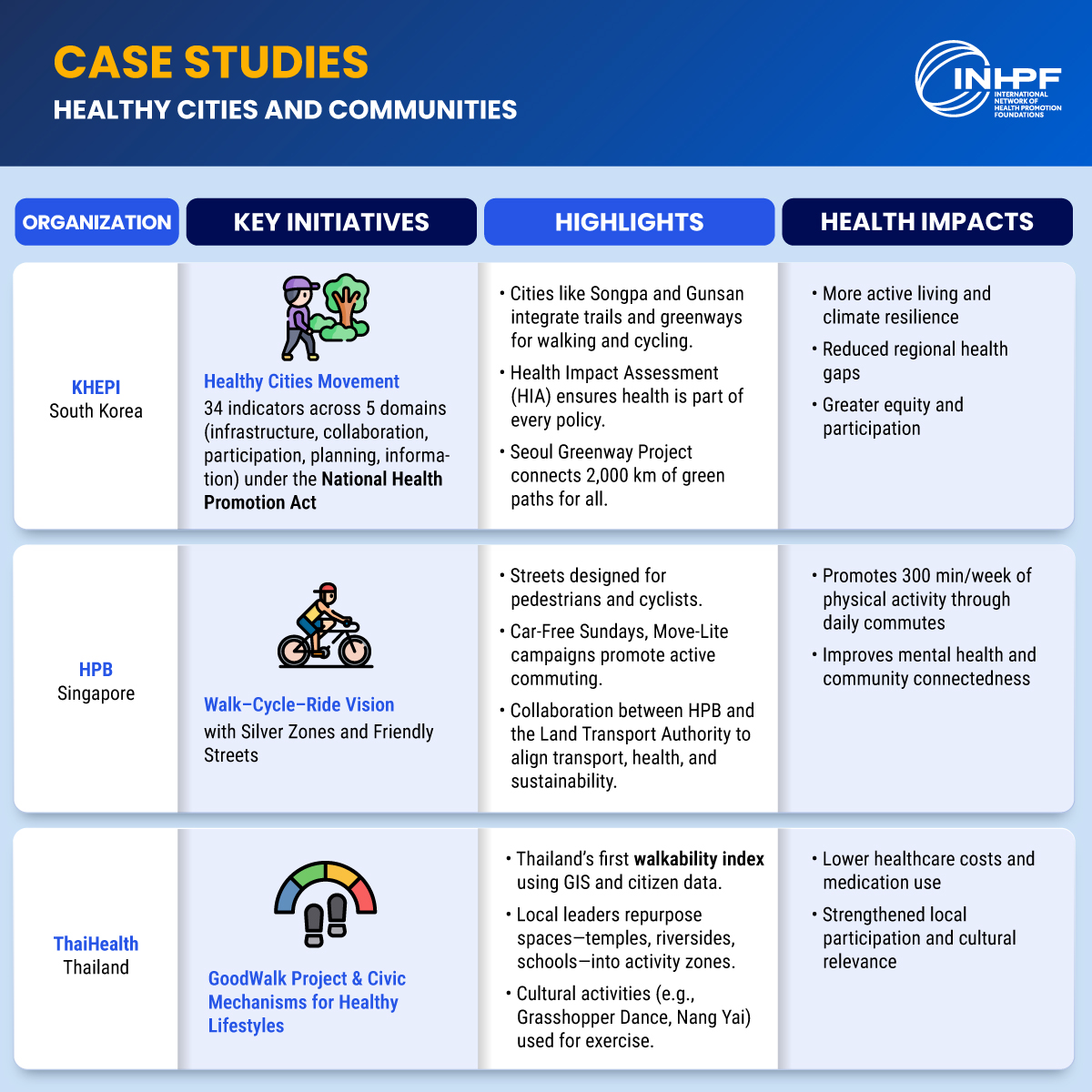
South Korea has placed health at the center of urban governance, recognizing that healthy cities are built not just on medical care but on the environments where people live, work, and move. Guided by the Korea Health Promotion Institute (KHEPI), the country’s policies under the National Health Promotion Act have institutionalized the creation of health-promoting environments.
The Healthy Cities movement, driven by KHEPI, transforms municipalities into laboratories of health-oriented urban design. The Ministry of Health and Welfare provides local governments with Healthy City Indicators and Guidelines; 34 indicators across five domains, including infrastructure, intersectoral collaboration, community participation, project planning and implementation, and urban health information system. Municipalities like Songpa-gu and Gunsan have become notable models. Songpa’s 21-kilometer circular trail connects green corridors and rivers, creating a seamless walking and cycling network that encourages active living for all ages. Meanwhile, Gunsan has converted abandoned railways into forest trails, blending recreation, ecology, and social engagement.
Beyond physical activity, cities such as Gangnam and Nowon integrate health considerations into all local policies through Health Impact Assessments (HIA), ensuring that environmental and infrastructure projects are evaluated for their health effects. The Health in All Policies (HiAP) approach reinforces public awareness and intersectoral accountability.
Complementing this policy framework, the Seoul Greenway Project represents a nationwide shift toward sustainable urban ecology. By 2025, Seoul will connect over 2,000 kilometers of continuous green paths, ensuring that every resident can access greenery within a five-minute walk. The project combines climate resilience, biodiversity restoration, and inclusive design such as barrier-free trails for all mobility levels, turning the capital into a living example of a climate-resilient and health-promoting metropolis.
These local innovations reflect KHEPI’s broader goal: to extend healthy life expectancy, reduce regional health gaps, and embed equity and participation into South Korea’s cityscapes.
Singapore: Designing Active Mobility for All
In Singapore, health promotion begins with movement. The Land Transport Authority (LTA) has pioneered the Walk–Cycle–Ride vision, redefining transport planning as a foundation for health, sustainability, and social inclusion. By designing streets that prioritize people over cars, Singapore transforms daily commutes into opportunities for exercise and connection.
Infrastructure plays a leading role in this transformation. Silver Zones and Friendly Streets redesign neighborhoods to slow traffic, enhance pedestrian safety, and create accessible environments for seniors and children. Public spaces such as the Civic District and Tiong Bahru have been repurposed into car-free cultural and community areas, where walking and cycling are not only practical but enjoyable.
Singapore’s approach extends beyond infrastructure, moving from “Hardware to Heartware.” Through campaigns like Move-Lite and community events such as Car-Free Sundays, citizens experience active mobility as a social activity that strengthens community bonds. Research collaborations between LTA and the Health Promotion Board (HPB) explore how transport design can influence physical activity, mental health, and healthy aging.
This strategy aligns closely with the Singapore Physical Activity Guidelines (2022), which recommend embedding movement into daily life. With most daily trips under five kilometers, LTA encourages residents to accumulate up to 300 minutes of moderate-to-vigorous activity weekly simply through walking, cycling, and stair use. The integration of transport, environment, and health sectors demonstrates how urban planning can function as a preventive health system in itself.
Thailand: Building Health from the Ground Up
In Thailand, the Thai Health Promotion Foundation (ThaiHealth) has developed a distinct model that connects community empowerment, local innovation, and environmental health. ThaiHealth’s guiding principle “Make the healthy choice the default choice” is visible in its city and community initiatives.
One flagship project, Good Walk, introduced the country’s first urban-scale walkability index, combining GIS data and citizen surveys to assess sidewalk conditions and accessibility. The results inform local planning, prioritizing areas where improved walkability can boost physical activity, reduce pollution, and strengthen neighborhood economies.
Another initiative, Capacity Building for Civic Mechanisms to Develop Ecosystems for Healthy Lifestyles, exemplifies the community-based approach. Implemented in provinces such as Rayong, Surin, and Ratchaburi, the program empowers civic leaders and volunteers to transform underused spaces such as temple courtyards, riversides, and school grounds into inclusive activity zones for all age groups. Cultural elements like the “Grasshopper Dance” and “Nang Yai” performances are reinterpreted as local physical activities, making health promotion both culturally relevant and socially engaging.
Data-driven learning and continuous mentorship underpin this initiative. Participants track physical activity and health outcomes, leading to reduced medication use and healthcare costs among residents. Through these mechanisms, ThaiHealth demonstrates how community design, civic participation, and cultural adaptation can turn ordinary public spaces into engines of health equity and sustainability.
Building Health-Promoting Workplaces
South Korea: Making Work a Foundation for Health
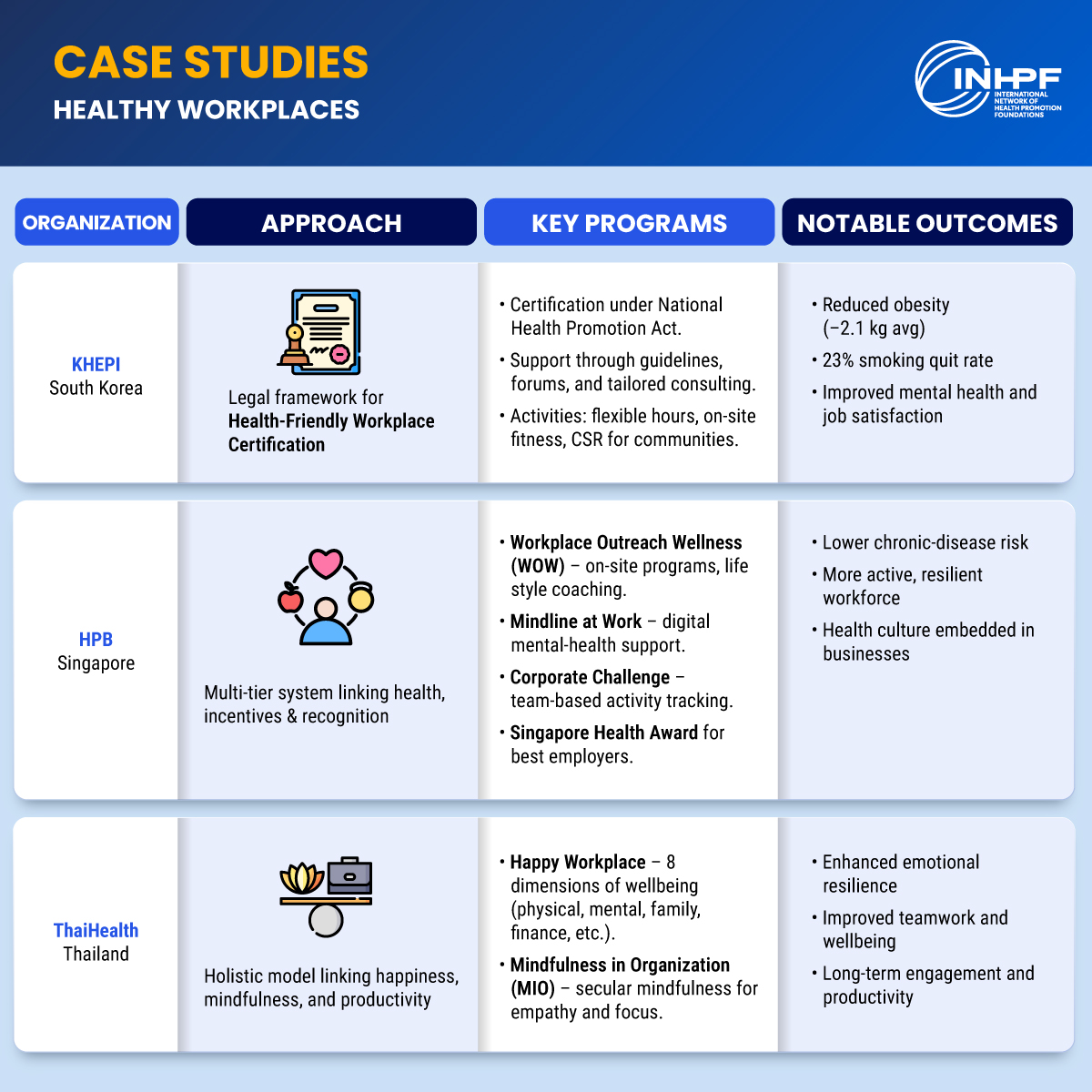
South Korea has institutionalized workplace health promotion through a strong legal foundation. Under Article 6-2 of the National Health Promotion Act, the Health-Friendly Workplace Certification system recognizes enterprises that cultivate environments enabling employees to manage their health actively. Administered by the Korea Health Promotion Institute (KHEPI) and the Ministry of Health and Welfare, the program turns corporate spaces into health-supportive ecosystems rather than stress-driven environments.
Certified companies are evaluated on three pillars; health-friendly management, culture, and activities. KHEPI supports these efforts through policy forums, guidelines for creating healthy workplace environments, and tailored consulting for employers at different development stages. The certification’s popularity is growing: in 2024, 62 companies applied and 26 were certified, each earning the right to display the official logo and benefit from government recognition.
Best practices illustrate how workplaces can embody the Healthy Settings principle.
- Return-to-Work & Adjustment Support: Certified companies offer rehabilitation and flexible-hour programs, physiotherapy, and structured exercise for workers recovering from injury or chronic illness.
- Healthy Environments: On-site nap rooms, counseling centers, and fitness facilities help employees rest, move, and de-stress during working hours.
- Corporate Social Responsibility: Certified firms extend health promotion providing health check-ups and diabetic meals for older adults living alone, or community nutrition aid for vulnerable groups.
Employee participation is embedded throughout. Executives often join company-wide fitness challenges or use stairs publicly to model healthy behavior, while staff volunteer clubs organize daily exercise sessions. Incentives including financial rewards for smoking cessation, further encourage participation. Evaluations include employee satisfaction surveys, ensuring that the voices of workers directly shape policy.
Collectively, these measures have produced measurable results: reduced obesity (average –2.1 kg among 431 employees over 2 years), a 23 percent smoking-quit rate, and improved mental-health indicators. Through this integrated approach, South Korea demonstrates how evidence-based management and supportive design can transform the workplace into a cornerstone of national health.
Singapore: Integrating Wellness into the Workday
Health Promotion Board (HPB) complements its city-wide active-mobility agenda with workplace-focused initiatives. The flagship Workplace Outreach Wellness (WOW) Program provides companies with co-funded, on-site, or virtual offerings covering physical activity, nutrition, and mental wellbeing.
Under WOW, organizations can schedule health screenings, one-to-one lifestyle coaching, and tailored workshops on stress management and diet improvement. The Guide to Workplace Health Promotion helps companies plan, implement, and evaluate their own wellness systems.
HPB also links employers to the national Corporate Challenge under the National Steps Challenge (NSC™), turning physical activity into a shared corporate goal. Teams track steps through the Healthy 365 app, building social motivation across departments. For mental wellbeing, HPB’s Mindline at Work platform offers self-guided digital therapy tools, mood check-ins, and more than 500 resources for emotional resilience that are available anonymously to any employee.
Recognition further drives participation. The Singapore Health Award celebrates employers that demonstrate excellence in health promotion, highlighting both large corporations and SMEs that embed wellness into their business models. Through this tiered ecosystem, combining infrastructure, incentives, and recognition, Singapore ensures that health becomes part of workplace culture.
Together, these programs advance the nation’s preventive-health agenda; reducing chronic-disease risks, improving productivity, and cultivating workplaces that model the same active, balanced lifestyles promoted across the city.
Thailand: From “Happy Workplace” to Mindful Organizations
Thai Health Promotion Foundation (ThaiHealth) approaches workplace wellbeing through a holistic lens, linking happiness, mental balance, and productivity. Its long-running Happy Workplace program, inspired by the WHO Healthy Workplace framework, addresses eight dimensions of worker wellbeing including physical and mental health, family relationships, financial literacy, and community spirit.
Operating nationwide and integrated into national policy dialogues, the initiative has reached over 10,500 organizations, positively affecting millions of workers. Participating companies receive guidance on creating supportive environments from healthier cafeteria menus to stress-management seminars and flexible work systems. Local temples and community centers often act as partners, providing accessible venues for relaxation and learning.
Complementing this is the Mindfulness in Organization (MIO) program, which brings psychological-based mindfulness practice into corporate life. MIO trains staff and managers to cultivate emotional regulation, empathy, and resilience essential competencies for both health and organizational effectiveness. Unlike traditional meditation programs, MIO focuses on practical, secular techniques rooted in cognitive science, helping teams manage stress and strengthen collaboration.
 Download
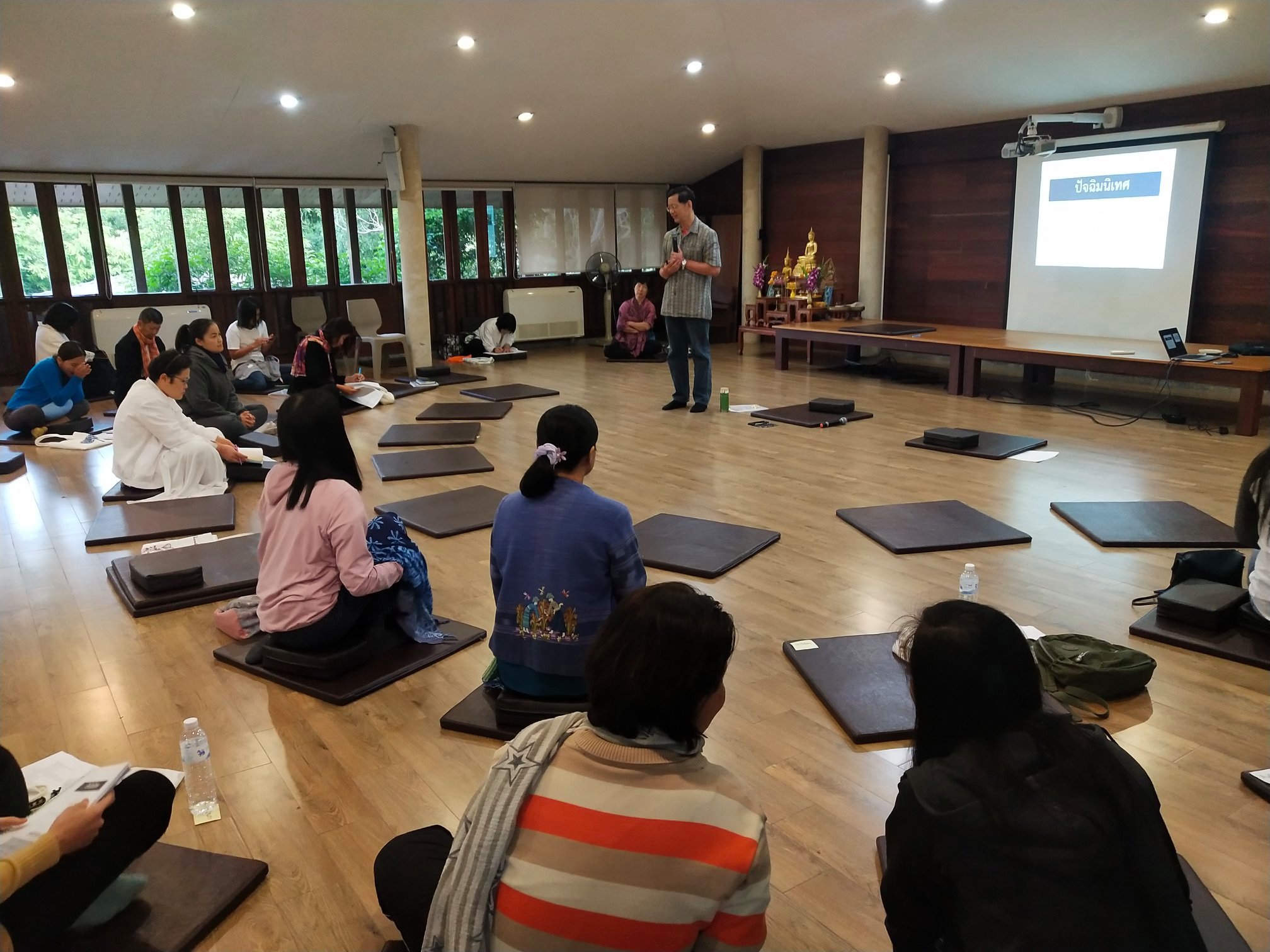
A session from the Mindfulness in Organization (MIO) program.
Image credit: Mindfulness in Organization (MIO), Thailand
By embedding mindfulness and happiness into management culture, ThaiHealth’s model redefines workplace health as a shared social responsibility. It moves beyond disease prevention to emotional intelligence, organizational harmony, and long-term engagement, demonstrating that healthier workers build not only stronger companies but also healthier communities.
Strategies for Building Health-Promoting Environments
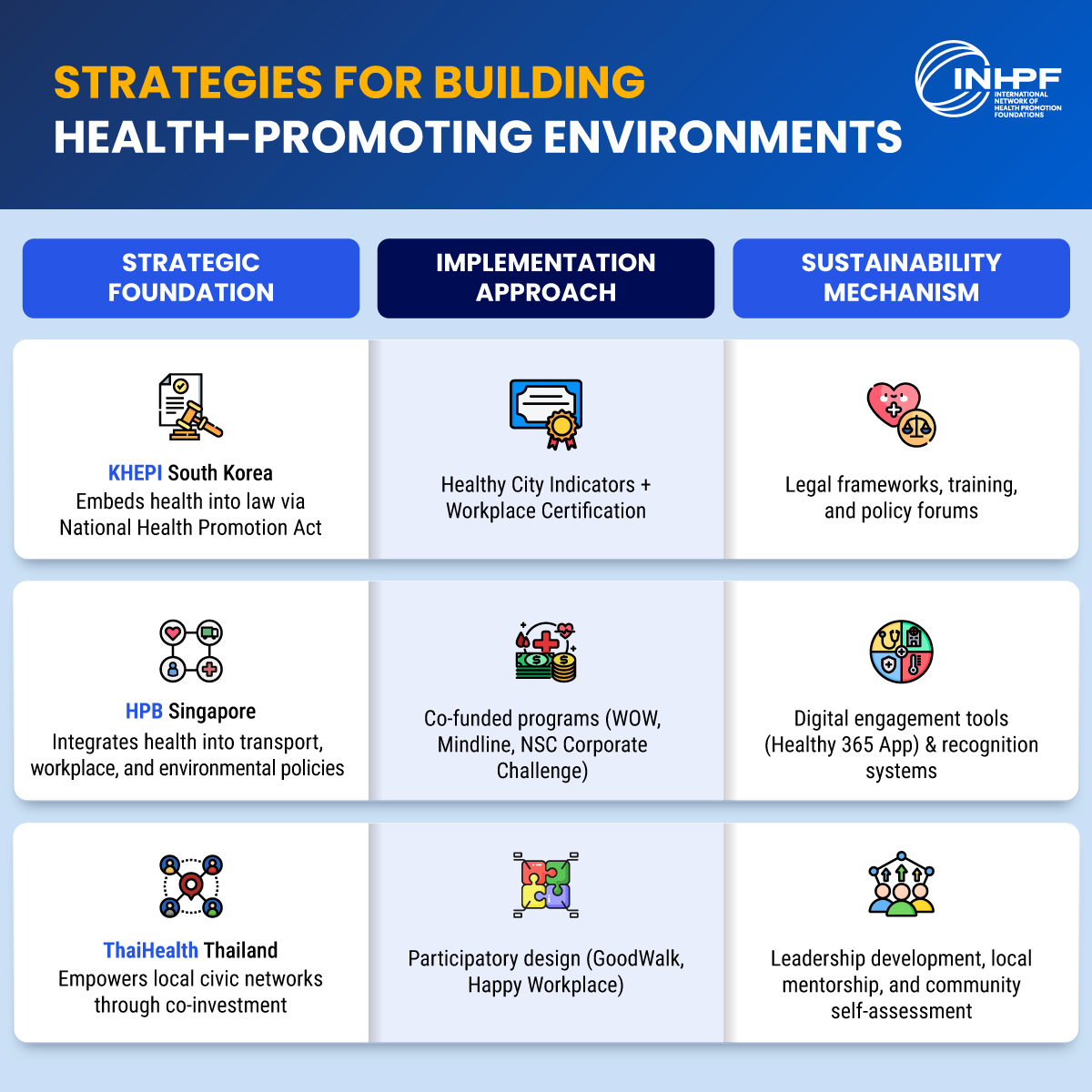
Strategic Foundation
- KHEPI: Anchored in the National Health Promotion Act, South Korea embeds health into law and governance. Articles 6-5 and 6-2 define the creation of Healthy Cities and Health-Friendly Workplaces, ensuring state and corporate accountability.
- HPB: Operates through policy integration and multi-sectoral collaboration, working with agencies like the Land Transport Authority (LTA) to connect health, mobility, and environment.
- ThaiHealth: Focuses on empowerment and decentralization, using a co-investment model and local civic mechanisms to drive health-promoting environments from the ground up.
Implementation Approach
- KHEPI: Standardizes progress through Healthy City Indicators (34 indicators across 5 domains) and a Health-Friendly Workplace Certification assessing management systems, culture, and activities.
- HPB: Provides co-funded programs like Workplace Outreach Wellness (WOW), Mindline at Work, and the Singapore Health Award, motivating participation through incentives and recognition.
- ThaiHealth: Emphasizes participatory design, engaging communities in projects like GoodWalk, Capacity Building for Civic Mechanisms, and Happy Workplace to create local, inclusive solutions.
Mechanisms for Sustainability
- KHEPI: Builds sustainability through legal frameworks, policy forums, and continuous practitioner training for local governments.
- HPB: Maintains engagement with digital tools and reward systems such as the Healthy 365 app and Corporate Challenge.
- ThaiHealth: Sustains outcomes through leadership development, local mentorship, and self-evaluation mechanisms within community networks.
All three organizations apply the WHO Healthy Settings framework but operate at different levels:
- KHEPI: Establishing a policy support framework through laws and standards, Supporting community implementation through policy-based foundations and Establishing an implementation framework through laws and standards
- HPB: Cross-sector integration and behavioral incentives
- ThaiHealth: Bottom-up empowerment and community co-creation
Conclusion
Creating health-promoting environments transforms health promotion from individual action into a shared social responsibility. Experiences from the Korea Health Promotion Institute (KHEPI), the Health Promotion Board (HPB) of Singapore, and the Thai Health Promotion Foundation (ThaiHealth) show that when health is built into policies, infrastructure, and daily systems, wellbeing becomes part of everyday life.
Each organization follows a different path; KHEPI through legislation and standards, HPB through cross-sector programs, and ThaiHealth through community empowerment, but all lead toward the same goal, enabling people to live healthier, fairer lives in environments that support them to thrive.
Reference:
KHEPI
- Ministry of Health and Welfare, Republic of Korea – National Health Promotion Act
https://www.mohw.go.kr/board.es?act=view&bid=0027&list_no=1483867&mid=a10503010200&nPage=1&tag - Songpa Trail of Hangang-gil – Seoul Metropolitan Government
https://english.seoul.go.kr/songpa-trail-of-hangang-gil/ - Seoul Greenway Project – Citywide Green Infrastructure Initiative
https://www.hapskorea.com/seouls-greenway-project-connecting-the-city-with-2000-km-of-green-paths/
HPB Singapore
- Workplace Outreach Wellness (WOW) Program – Health Promotion Board https://www.hpb.gov.sg/workplace/workplace-outreach-wellness-programme
- Essential Guide to Workplace Health Promotion https://www.hpb.gov.sg/workplace/useful-information-for-organisations/essential-guide-to-workplace-health-promotion
- National Steps Challenge™ Corporate Challenge
https://www.healthhub.sg/programmes/corporate-challenge
ThaiHealth
- Happy Workplace Program – ThaiHealth
https://happyworkplace.thaihealth.or.th/ - Mindfulness in Organization (MIO) – Thai MIO
http://www.thaimio.com/
Download the full infographic
Explore how Korea, Singapore, and Thailand are building health-promoting environments through urban design, workplace innovation, and community-led solutions.
Download Full Infographic (PDF)
Read next
Discover how Health Promotion Foundations are addressing health inequities through food systems and physical activity initiatives in How HPFs Tackle Health Inequities through Food and Physical Activities.
Explore the Network
Learn how Health Promotion Foundations across our global network are working together to advance health and equity.
About INHPF: https://inhpf.org/about/
More insights from the Network
Visit our Insights page to explore case studies, strategies, and evidence from member organizations.
https://inhpf.org/category/insights/
Image Credits
- Banner and Thumbnail: Happy Workplace website, Thai Health Promotion Foundation (ThaiHealth)