


Issued: 15 December 2025
(The headings below are added for online readability. The statement text remains unchanged.)
The International Network of Health Promotion Foundations (INHPF) notes with concern the recent decision to absorb the Victorian Health Promotion Foundation (VicHealth) into the Victoria State Department of Health.
We acknowledge the significant fiscal and policy pressures that governments face globally, and express our respect for the challenging decisions required in the current environment. At the same time this development occurs at a critical juncture when global population health trends underscore the urgent need for strengthened prevention capacity.
Growing Global Burden of NCDs
According to the World Health Organization (WHO), noncommunicable diseases (NCDs) now account for 75% of non-pandemic-related deaths globally, claiming at least 43 million lives annually. Nearly 1.8 billion adults worldwide remain at elevated risk due to behavioral and environmental factors, while chronic diseases continue to drive the majority of healthcare costs and preventable disabilities across nations. These trends represent not merely statistics; they point to a collective imperative for effective evidence-based prevention approaches, an area in which VicHealth has been internationally recognized for leadership for nearly four decades.
VicHealth’s Global Contribution
As the world’s first health promotion foundation set up in 1987, and a designated WHO Collaborating Centre for Leadership in Health Promotion since 2014, VicHealth has long been regarded as a global pioneer in health promotion. Its leadership has contributed expertise, evidence and policy innovation that have shaped prevention systems in Australia and internationally. Many countries have looked to VicHealth as a model for developing strong, independent health promotion agencies capable of improving population health at scale.
VicHealth’s evidence-based approaches have yielded measurable population health improvements that extend far beyond Victoria’s borders. Its pioneering work in removing tobacco sponsorship from sports and arts, coupled with comprehensive prevention campaigns, helped shift Australia toward one of the world’s lowest smoking rates among developed nations. Through rigorous research and community partnerships, VicHealth developed scalable models for addressing social determinants of health. Its methodologies have influenced the establishment of health promotion foundations in multiple countries.
Equally significant is VicHealth’s local impact. Its independence, supported by a stable and trusted mandate, has enabled it to build strong community relationships, respond to emerging needs and sustain long-term prevention efforts. Through dedicated funding, VicHealth has supported generations of researchers, practitioners and more than 500 community organizations each year, strengthening equity, resilience and wellbeing across Victoria. These networks are not easily rebuilt once disrupted.
The Role of Health Promotion Foundations
INHPF’s collective experience across multiple health systems demonstrates that Health Promotion Foundations possess unique capabilities essential for addressing today’s complex health challenges. Their ability to adopt a long-term vision, champion evidence-based positions, cultivate deep community trust and act with agility has proven critical in achieving population-level impact.
A Call to Strengthen Prevention Infrastructure
INHPF respectfully calls upon governments worldwide to recognize that robust prevention infrastructure are essential investments in population health and economic sustainability. The evidence is clear: every dollar invested in evidence-based prevention yields multiple dollars in reduced healthcare costs and improved population outcomes. Recent evidence from Australia reinforces this point. A Queensland community-based diabetes prevention model implemented by Health and Wellbeing Queensland (HWQld) generated an 82 percent return on investment, illustrating the system-wide value of prevention. National data similarly show that nearly half of Australians live with at least one chronic condition, and each dollar invested in prevention can return up to fourteen dollars in economic and health benefits.
We urge policymakers to recognize prevention as essential health system infrastructure, and to:
- Maintain or establish dedicated health promotion agencies with sustainable funding streams protected from acute care pressures
- Invest in evidence-based prevention programs that address social and commercial determinants on health
- Support international knowledge sharing that amplifies successful prevention approaches across borders
Closing Statement
The challenges facing global population health require the very type of effective evidence-based leadership that VicHealth has exemplified. As an international network committed to health promotion, INHPF shares a responsibility to ensure that the knowledge, approaches, and institutional capabilities that HPFs represents continue to benefit the global health promotion movement.
INHPF stands ready to support efforts to preserve and strengthen independent health promotion capacity worldwide, drawing upon the collective wisdom and experience of our member foundations to address the health challenges of the 21st century.
Download the Official Statement (PDF)
https://inhpf.org/wp-content/uploads/2026/01/INHPF_Statement-VicHealth.pdf
About INHPF
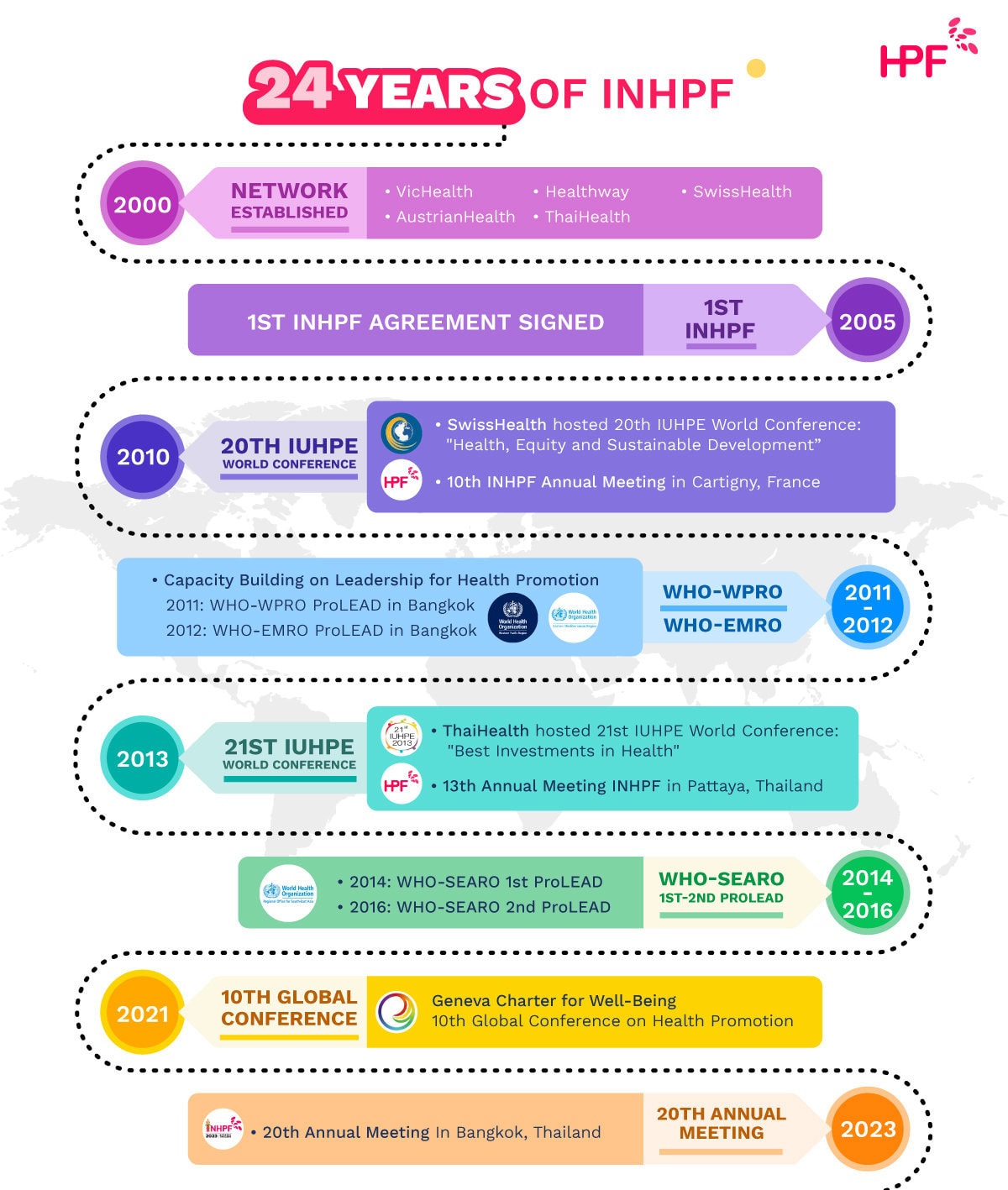
The International Network of Health Promotion Foundations was established in the early 2000s as a global network of Health Promotion Foundations committed to sharing knowledge, experience, and innovation to enhance international health promotion efforts.
Learn more about INHPF: https://inhpf.org/about/